H
Hakea salicifolia 'Gold Medal' GOLDEN WILLOW LEAF HAKEA spring colors, UCSC Arboretum fall colors, UCSC Arboretum another spring UCSC specimen humble flowers, closeup GOLDEN WILLOW LEAF HAKEA a stunning, drought tolerant, Mediterranean-climate foliage plant, with warm coral pink to bright clear pink spring growth displayed against blonde-white to light golden yellow variegated leaves and burgundy stems. The flowers are quite small and not showy, being spidery white things held right against the branch and dwarfed by the much more noticeable leaves. It will slowly grow into a large shrub or small tree to 10', possibly more with age, and spreads about as wide. Specimens planted at UCSC in the late 1970's are now about 12-15' tall and as wide, after 35 years. A fantastic choice for a small focal point tree, as hedges, screens or windbreaks, it takes sun or part shade, tolerates wind and very wet soils in winter and needs very little watering when established. This is a really good plant that has always suffered from being quite difficult to root from cuttings and tending towards reverting to all-green. We believe we have eliminated almost all reversion tendency in our crops. As I remember it has not been damaged by any of our local tragic epic freezes since being planted, including 1990 or 1998. USDA zone 9 (8a?)/Sunset zones 8-.9, 14-24. rev 9/2014
Hakonechloa macra HAKONE GRASS low, moderately fast, clumping deciduous grass with thin, arching stems to 12" tall. Graceful, dark green leaves arch over in a very soft manner. They turn dark maroon in late fall before dropping, and the color in this form is more intense than in its much more common variegated sport, ‘Aureola.’ The deciduous period has been very short for us, new growth starts early in the new year. Seed heads are relatively attractive. Full to part sun, average watering, frost hardy. Great in containers. This plant greatly enjoys moist, acidic conditions, so be free with the peat moss and when in doubt add a little soil sulfur as well. Japan. To about 12-16" tall in most California applications, taller (30-36" tall) in more East Coast conditions. USDA 5/Sunset zones 2-9, 14-24. Graminae/Poaceae. rev 4/2012
'Albostriata' JAPANESE FOREST GRASS close nice Portland groundcover this form is almost the same as 'Aureola' but with creamy white variegation on these soft, arching leaves, as opposed to yellow. I think this selection's cream color highlights the pink fall color change better than its partner. Feature this where its delicate leaves can drape gracefully over the sides of containers, walls, or especially the water's edge. Not at all invasive, it slowly spreads its clumps in cool, moist soil. rev 4/2012
‘All Gold’ at Lance's house leaves close up the all-gold sport of the most common form, ‘Aureola’ this form offers glowing, pale yellow foliage and exquisitely slow growth. rev 9/2011
‘Aureola’ GOLDEN HAKONE GRASS planting foliage fall color much slower growing than the all-green form, with yellow leaves striped with green. To about 30" across by 16" tall. The leaves turn light pink as the plant begins to go dormant. Very bamboo-like, probably the most distinguished variegated small grass. Very classy! rev 9/2011
Hardenbergia three species of vines and scandent to recumbent spreaders, native to Australia. Two species are found in the trade here. Leguminosae/Fabaceae. rev 8/2020
comptoniana (not currently in production) flowers really closeup a fast twining evergreen vine with dark green, divided leaves. It produces a massive show of dark violet blue flowers in narrow pendant clusters in late winter and early spring. Each of the two upper petals sports a small, natty white and green spot. Showier, faster, more vining, and slightly more tender than the more common H. violacea cultivars. Also reputed to not be as long lived. Sun to part shade, little or no summer watering. Needs good drainage. This species ranges from the subtropical Mediterranean coastal plains well north of Perth through the much cooler/winter-cold Albany, at the very southernmost tip of the Western Australia. Forms in the US seem to be damaged or killed below 25°F. Western Australia. Reportedly this species is phosphate insensitive, unlike the following species. rev 8/2020
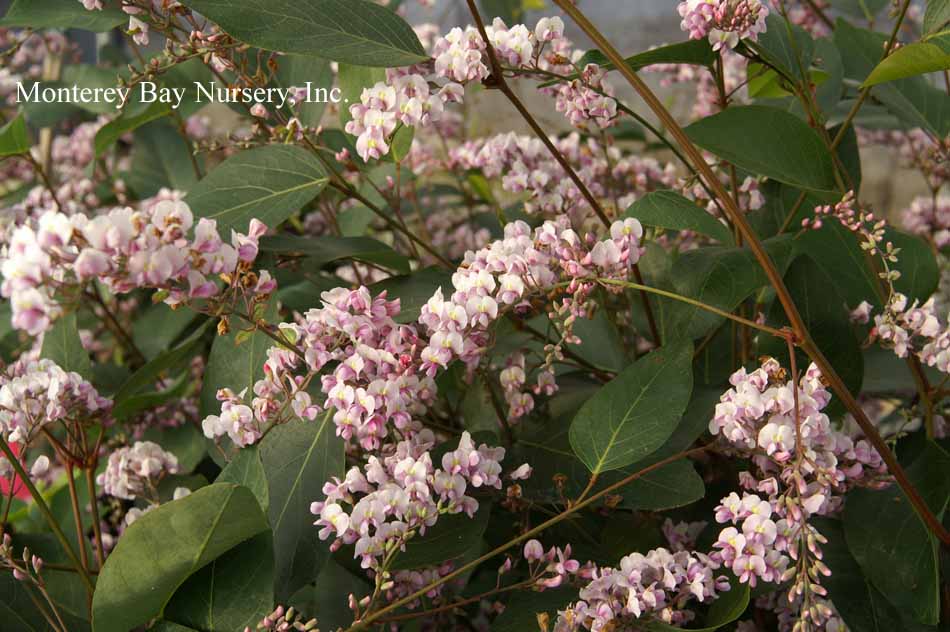
pink (not currently in production) flowers really closeup pale pink flowers, same growth habit and characteristics as the excellent standard purple-blue form. MBN INTRODUCTION-1995 rev 8/2020
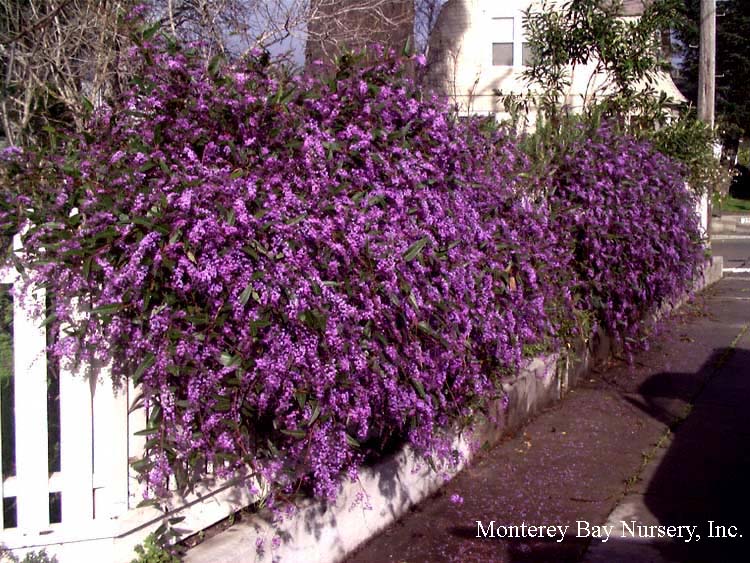
violacea HAPPY WANDERER, VINE LILAC, PURPLE CORAL PEA, FALSE SARSAPARILLA a moderately fast grower with (usually) violet purple flowers, with a tiny greenish spot on each of its two upper petals. It can make a very heavy show, usually from January or so through the end of March, sometimes longer. It is at least partially chill-responsive however and in cool summers here seasonally mature stems will initiate and show buds forming as early as late July in some years. In Australia I encountered this in the wild growing mostly as a scandent or mounding bank cover on roadcuts and other dry, hot, open spaces. Though less vining than its sister species H. comptoniana it does twine readily though when it encounters support and in horticulture it is used almost exclusively as a large, enthusiastic vine, almost always improving fences. Sun to part shade, little or no summer watering. Can be slow to establish in some very dry situations, but is usually fast once its roots are down. The young leaves are reportedly somewhat edible and utilized as a form of chewing gum, the roots have been used as a sarsaparilla substitute (tea). It is fire adapted and old, twiggy plants can be cut to the ground in late summer or early fall, resprouting from the crown. Tops are hardy to ~25°F, roots 5-10°F lower, maybe more. This species is highly sensitive to phosphate, which shows up as marginal lightening and necrosis in the foliage as well as overall stunted growth. rev 8/2020
‘Alba’ WHITE HARDENBERGIA (not currently in production) flowers mounding shrub or slow vine with somewhat oval leaves and a heavy show of small, pure white pea flowers in late winter. Our plants are derived from a seedling of 'Happy Wanderer.' rev 8/2020
‘Happy Wanderer’ closeup another closeup habit more habit a fast vine, or mounding, shrubby groundcover, to 3-4’ tall, 10’ wide or more. Masses of medium-dark violet purple flowers cover the plant from as early as November in some years March or even April. In eastern Australia where it is native, it is often encountered growing naturally as a compact, sprawling ground cover on bare road cuts. In spite of its confluence with one of its Australian common names this is a clonal, cutting-grown variety with a more strongly vining habit than most wild forms, also superior flowers and longer, shinier leaves. It was originally imported to this country through Duncan and Davies of New Zealand. It rarely makes seed after flowering. When the few seeds produced are grown out besides showing a range of colors the seedlings display a markedly different and mostly inferior form, with duller, rounder leaves and a much bushier, less vining habit. Undamaged at 25°F, it suffered enough damage in containers at 20°F that many 1g plants didn't survive, possibly due to soil freezing or inadequate stored resources in the young root systems. UC Santa Cruz. Eastern Australia. rev 8/2020
rosea (not currently in production) closeup slightly rounder leaves and a more compact habit. Flowers are light pink, with slight salmon overtones. Our plants are derived from seedlings of 'Inspiration,' a form almost identical to 'Happy Wanderer' but with medium pink flowers, received from Duncan and Davies sometime around 1989. It turned out to be carrying a virus common in the trade in Australia and New Zealand and we destroyed all the original plants. Duncan and Davies never offered it again. As is usual the seedlings were free from the virus but remain inferior in leaf and habit and set large amounts of seed as well. rev 8/2020'White Out' clouds of flowers a newish, pure white counterpart to 'Happy Wanderer,' featuring almost identical foliage appearance and growth habit. Almost no seed set. Excellent! rev 9/2020
Haworthia Huntington greenhouse collection more even more! cute, attractive, small scale, clumping, rosette-forming plants that are some of the easiest succulents to grow and succeed with, usually surviving for years and years if given the most rudimentary attention. The main attraction is in the wide variety of leaf conformations, markings and coloring but almost all reward you with very long, ultra-thin flower stalks, reaching up far above the plant and arching over, bearing airy, extended clusters of tiny, white, lily-like flowers, usually marked with a thin green stripe. Nothing quite makes you feel like a true succulent expert than watching one of these pets flower, in spite of doing almost everything wrong, and this while the rest of your collection either withers away or rots off at the base. Those flowers are proof you know what you are doing! Many species look like miniature, green Century Plants, others have blunt, window-like leaves or dramatic stripes, spots or ridges. Those translucent leaf windows can vary their transparency, and help the plant moderate photosynthesis and moisture loss by admitting or excluding light. Grow all in any reputable, succulent-worthy potting mix except for a few collector-types which demand sharper drainage, more careful watering and closer attention to seasonal growth and rest cycles. All are long day growers except for those needing a midsummer rest, when they are growing new roots for the current-year and prefer drier conditions then. Almost all varieties we grow seem to be short day flower initiation, possibly with some daylength-independent chill response as well. Haworthias can hybridize with sister genera Aloe, Astroloba and Gasteria. Recently a proposed is division of some current Haworthia species into the new genera based on DNA evidence as well as previously noticed flower differences. The two new groups are Haworthiopsis (encompassing such traditional stalwarts as H. fasciata, attenuata, coarctata, tessellata, among others) and Tulista (H. kingiana, marginata, minor and pumila). Asphodelaceae, formerly Liliaceae. rev 7/2020
attenuata ZEBRA PLANT typical flowers young greenhouse-grown plant garden edge-planting a small, clustering species that grows east of the Cape, close to but distinguished from H. fasciata by having tubercles on both the upper and lower leaf surfaces, versus just lower for the latter. Typical small white flowers on long, very slender stalks. Now classified as Haworthiopsis attenuata by some authorities.USDA 9a/Sunset zones 16-7, 21-24. rev 7/2020
attenuata ssp. attenuata COMPACT ZEBRA PLANT chunkier, shorter, broader leaves. rev 10/2017
'Big Band' BIG BAND ZEBRA PLANT the ultimate penultimate (because Super Big Band is now in the building) in whitely-banded goodness, extra-wide and extra-heavy whiteness slathered all over the backs of the leaves. More bodaciously bold banding for your buck! If this description doesn't reach you, give up. You can't be reached. Typical dimensions, clumping to 6-8 inches tall and forming big clusters with age, and typical Zebra Plant growing conditions. rev 2/2021
'Super Big Band' the unholy mother of bandedness, the holiest, most righteous, most ultimate bands. rev 2/2021
v. obtusa round nubs, barely sticking out of the soil when hiding from heat, dry air and intense sun, then forming taller clumps under cooler, more humid, moister and more shaded conditions. Looks very much like v. truncata until older, when leaf tips remain rounded and blunt but essentially still pointed, versus developing a flat face. Some equivalate this name with v. truncata, others consider it to refer to a different trade form as we do here. IPNI does not list this variety as being a valid published scientific name. rev 9/2020cymbiformis Huntington? tight rosettes of plump, translucent leaves. Pups free to form tight clumps. rev 9/2020
form A another angle broadish leaves, almost white ridges. rev 6/2020mutica dark green leaves, tops are flattened as they face horizontally, with a few faint lines for decoration and a translucent surface to moderate light/heat levels entering the leaf. A slow grower, and tight but reliable clumper. Typical white flowers on very long, wiry stems, short day. My favorite?? rev 1/2019
form B narrow whitish ridges, rather purplish tips. rev 6/2020
form C very fine, dense, perfect ridges on very wide, cleanly spiraled rosettes. rev 6/2020
Hebe daughter of Zeus and Hera, wife of Hercules, goddess of youth. I'll bet you didn't know almost any of that! Evergreen shrubs and subshrubs, formerly important stalwarts in California landscaping, but now essentially extirpated due to the introduction of Fusarium oxysporum v. hebei. This disease persists in soils and nursery beds for years, and induces systemic, incurable, fatal stem and crown infections which ravage landscapes and commercial crops. By the early 1990's Hebe had essentially left the commercial trade in California. In Oregon and Washington however they do not seem as affected by that disease. You will occasionally find relictual individuals throughout California, free of the disease due to being clean when planted and living in uninfected soils. They were re-evaluated in the Willamette Valley in an extensive and extremely valuable trial conducted by Neil Bell of Oregon State University. He looked at hardiness, drought resistance and disease resistance. They were broadly reintroduced in the Portland-Seattle area recently following this planting and now serve quite effectively again in California, but s short-term flowering container color items, with the smaller leaved varieties showing even better application as foliage color/texture elements in single or mixed containers. They break into three basic groups: big leaves and showy, large flower spikes, tight, dense, box-like foliage in grey or green, and whipcord types with minute, scale like leaves and stringy branches. Plan on using the bigger, softer kinds strictly in that container capacity in California since the limiting disease is so extensively and permanently entrenched here in nurseries and gardens. Some of the smaller leaved types can be more resistant and may be tested in the ground, but don't come crying to us if they die - you have been forewarned! New Zealand. Scrophulariaceae. rev 10/2017
andersonii 'Variegata' VARIEGATED HEBE blooming, mature foliage a low evergreen shrub to about 30" tall, bearing short spikes of violet purple flowers in late winter and spring. Jade green leaves are splashed with creamy white along the margins, and are half-mixed across most of the rest of the leaf. Juvenile foliage is longer, narrower, greener, and with longer internodes. Stems are light reddish brown and provide some contrast. This is a cute foliage or container plant, useful for its excellent tone of green in the foliage as well as its variegation, as a focal point, contrast, or background plant. This is actually H. "x" andersonii, the "x" indicating that this is an artificial, hybrid "species," but the "x" just makes the name cumbersome for listing, labeling and organizing purposes so we don't use it. Sunset zones 5-9, 14-24/USDA zone 8. rev 2/2010
anomala 'Purpurea Nana' fine, box leaves small, attractive, dark green leaves with purple red growing tips. When pruned, after flowering its white flowers, you will have even more growing tips and more purple red color! Evergreen, about 2-3' tall and wide. Delightful in a container. Sun, regular watering. USDA 7/Sunset 5, 14-17. rev 3/2015-Suzy Brooks
buchananii 'Minor' (not currently in production) tight foliage a miniature box-leaved species, with tight, dense blue grey foliage, each leaf edge neatly lined with burgundy during the cool season, on branches to about 4-5" tall, and spreading to about a foot. Reportedly shy-blooming, with white flowers on short spikes. This is classically a rock garden subject, for those who delight in growing plants in stone sinks filled with crushed granite and watering twice a day. But it has found new life as a simple container or even better, combo element plant. It is rather adaptable in typical UC-type mixes (bark/sand, some perlite, etc.) and especially clay pots where excess moisture is wicked away and evaporated by the container itself. Use it for its tight, regular blue grey leaves and perfectly opposite leaf/branching habit. This is probably frost hardy for all but the very Highest Sierras and will certainly sulk or die under desert conditions as well. Sunset zones 4-9, 14-17, 21-24/ USDA zone 7. rev 3/2010
cupressoides 'Nana' compact habit on quart plant a whipcord speceis of Hebe that grows very slowly into a round ball, 1-2' tall and wide. A good choice for small containers, with alpine plants in a trough, or as a tree in a fairy garden or garden railroad landscape. Sun or part shade, regular watering, and well drained soil. Evergreen, has small lilac flowers in summer. Sunset zones 6-9, 14-24/USDA 8. rev 2/2012-Suzy Brooks
diosimifolia 'Aute Wainia Falls' very close you grow this because you want a compact mound of neat, tidy, very glossy and very dark green foliage. The flowers are heavily produced, so it is worth growing for more than just the habit and foliage, like many of the obsessively neat, regular plants in this genus. It slowly (slowly!) forms a dense evergreen shrub to about 2' tall and wide. The clusters of bright white flowers are tinged with the faintest violet. This is especially terrific in containers where it looks good all the time, it forms an outstanding backdrop for other plants or can be featured by itself. Sun or part shade, regular watering. I am pretty sure we acquired this from UCSC. Sunset zones 14-24/USDA 9. rev 10/2011
evenosa (not currently in production) leaf habit a compact, green, box-foliage type, rather slow growing, with short, loose spikes of white flowers in late spring and summer. To about 2-3' tall and wide. Provides very nice color and texture in containers and mixed plantings. It is frost hardy enough to be raised in Portland and even the Seattle area. Sunset zones 4-9, 14-17, 21-24/ USDA zone 7. rev 3/2010
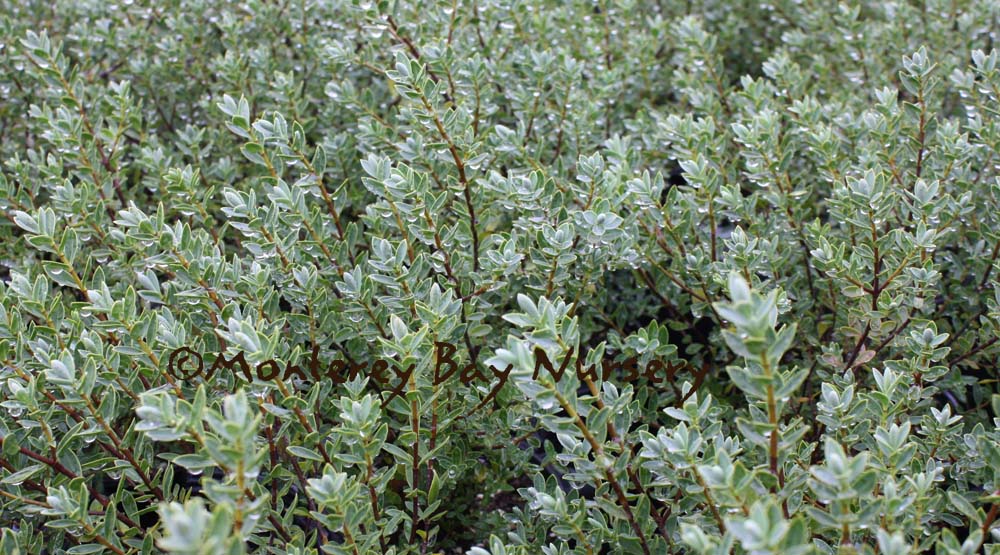
glaucophylla (not currently in production) bluish foliage here's some hedge material that's 'outside the box,' blue grey colored foliage with new leaves looking like little oval buds at the tips. About 18" tall and 30" wide. An alternative to boxwood. Also nice in containers, try it with Black Mondo grass and a small Armeria. Sun or part shade, average watering. Sunset zones 1-24/USDA 6. rev 5/2012-Suzy Brooks
'Greensleeves' (not currently in production) very fine green foliage very small, bright green leaves pack the whipcord-stems of this neat, petite, evergreen shrublet, growing to only 18-24" tall at full maturity. Small white flowers are produced in narrow spikes in early summer. This is a beautiful texture for use primarily in containers, and it is especially good in combination plantings and definitely fine enough for fairy gardens. The whipcord types are generally far easier in California gardens, being much more resistant to the strain of Fusarium fungus that removed most forms from the landscape trade way back in the 1980's. Sun (cool coast) to part shade (everywhere else), regular to modestly infrequent watering, USDA zone 9/Sunset 14-24. rev 10/2014
'Hinerua' neat, supple foliage ultrafine, dark, rich olive-green whipcord leaves are held with cruciate regularity on a soft, billowy, upright, evergreen shrub. Grows 2-3' tall and 4-5' wide, it likes sun or part shade and average watering. Beautiful foliage alone or planted in groups. Sunset zones 4-7, 14-24/USDA 7. rev 10/2013
imbricata (not currently in production) foliage another intriguing whipcord-type, with densely clasping, juniper-like leaves of deep coppery brown. Grows as a tight, spreading, flat dome to about 18" tall by 3' or more across with great age. Like all hebes, in California this is best treated as a container plant, though it can survive in the ground as a rockery/alpine unit if Fusarium oxysporum v. hebeii from prior plantings. Sun to more than half shade, average watering, hardy to at least Sunset zone 5-9, 14-17, 23-24/USDA zone 8 or 7. rev 7/2012
masoniae small, neatly stacked leaves a tidy, well-behaved little evergreen shrub with leaves of dark green stacked neatly in geometric perfection, and white flowers in short spikes appearing on the branch tips in the summer. About 20" tall and wide, another nice choice for containers or any sunny spot with decent drainage and average watering. USDA zone 9/Sunset 14-24. rev 11/2014
'McKeanii' (not currently in production) perfectly neat foliage in the thirty years that this has been around it has picked up many names, 'Emerald Gem,' 'Green Globe,' all describing a charming, dense ball of small, bright green leaves growing about 12" inches tall and 18" wide. In small pottted gardens or front of the border, it is an easy to grow shrub for sun or part shade with average watering. USDA zone 9/Sunset 14-24. rev 10/2014-Suzy Brooks
ochracea 'E.C. Stirling' new plant this is a dwarf form of 'James Stirling,' only gets about 12" tall, and has golden chartreuse foliage and minute, cypress-like leaves. Call it an moderately dense whipcord type, it almost looks like a golden juniper. This is primarily suited to small spaces, and especially as a container subject, either by itself or combined. Sunset zones 6-7, 15-17, 21-24 / USDA 7b-9. rev 2/2010
'Pinocchio' (not currently in production) flowers plus leaves green and creamy white unevenly splash these leaves and provide a wonderful backing for the short terminal spikes of medium violet purple flowers. This is a small evergreen shrub to about a foot tall and wide. Adds sparkle to containers, mixed with other plants or alone. Provide sun or part shade, average watering. USDA 8/Sunset 8-9, 14-24. rev 2/2015
'Purple Shamrock' leaves and stems green and cream colored foliage picks up a pinkish purple in cool weather, contrasting stems are dark burgundy all the time. This really pretty little shrub grows to 2' tall and wide and likes sun or part shade. Compact and evergreen, it makes a charming container choice and a delightful hedge. Mauve flowers in short spikes are produced in summer. Average watering, drainage, full to part sun. USDA zone 8/ Sunset zones 8, 9, 14-24. rev 9/2014
'Red Edge' (not currently in
production) red edge
an evergreen shrub with greenish-grey foliage and a thin
red edge around each leaf. Low and rounded, to about 2' tall
and 2-3' wide. Blooms in summer with spikes of lilac flowers
fading to white. This would be nice up close so you could
appreciate the 'just so' stacking of the leaves, like in a pot by
the patio table, with a small dark groundcover under it. Sun or
part shade. Likes well-drained soil and regular water. Zones
5-7,14-24, USDA 7. rev 7/2010
topiaria (not currently in production) compact habit forms very tidy, compact mounds of small, silvery green leaves with a pale edge. Grows about 3' tall and 4' wide. A good choice for a small hedge or a container subject, alone or in combinations. This performed well in the Oregon State field trial where many plants failed due to Fusarium (among other causes, like drought, and cold) but should not be considered reilably resistant in landscapes until definitively shown to be so. Sun or part shade, appreciates good drainage, regular watering. Sunset zones 7-9, 14-24/USDA 7. rev 10/2010
venustula nice foliage effect an open to moderately open sub-shrub, reaching just 24-30" in height, that you want to grow for its amazingly regular, book-like foliage. The stems tend to show a wonderful monopodal growth pattern. Flowers are small, pale lilac blue, and make a nice show in spring. In nature it tends to grow on slopes so make sure it has good drainage. It is a great foliage element for combinations. I have seen this doing well at Neil Bell's OSU Hebe trial in the Williamete Valley. Zones 7, 14-24/USDA 8. rev 6/2010
'Sky Blue' neat stacks such amazing petite leaves, in such an orderly fashion, shiny and happy, a tidy little evergreen! Only about 2' tall and half as wide. It is almost hypnotizing looking at the mostly monopodal growth and perfectly neat, regular leaves. Best as a container plantbut can also be used in gardens, where it looks great as a low foreground mound or placed near rocks or other attention getting objects/plants. Expect light, lavender flowers in spring and summer. Sun or part shade, and regular watering. Sunset zones 14-24/USDA 9. rev 10/2011
'Walter Buccleugh' (not currently in production) very nice flowers! very nice foliage! this one has green leaves with reddish margins and is more of a low spreader, growing 18" tall. Soft texture and the smokey, dark color are punctuated by violet flowers, it goes well in front of the border or in rock gardens. Evergreen shrub for sun or part shade and average watering. More tolerant of cold than most, to USDA zone 7/ Sunset 7-9, 14-24. rev 10/2014-Suzy Brooks
'Western Hills' (not currently in production) dark stems wiry, greenish yellow stems turn to rich mahogany on this dense, evergreen shrub. Leaves are bluish green and white flowers appear on spikes in summer. 30-36" tall and wide. Sun, regular water. Sunset zones 1-24/USDA 5. rev 4/2011
Hechtia
epigyna green
clump a relatively frost-hardy, clumping Mexican
landscape bromeliad, forming clusters to 5-6' across at
maturity. Light pink flowers, on tall, thin, branched
stalks, are seen in early spring and reach 3-4 tall. Use it
like a thin-textured, shiny, green, toothed Agave, sited away from paths. Sun to
mostly shade, average drainage or better, very little summer
watering required when established. USDA zone 9/Sunset 8-9,
13-24. Bromeliaceae. rev 6/2016
Hedera helix MINIATURE ENGLISH IVY slow (mostly) varieties, with smaller, often colored leaves. Shade to part sun, infrequent watering when established. Appreciates good drainage, and of course, great in containers or as a house or patio plant. Europe. Araliaceae. rev 6/2017
'Erecta'
upright stems
obsessively vertical, with leaves stacked neatly above each other
in two ranks on opposite sides of the stems. Dramatic and unique.
rev 3/2019
'Glacier'
leaves
medium green juvenile leaves are splashed with a little grey and
bordered thinly by creamy white, mature leaves mostly grey with an
even thinner white margin. rev 6/2017
'Gold Child' leaves mostly
grey, plus dark green, gold margin. rev 6/2017
'Gold Heart' leaves rounded, often
heart-shaped juvenile leaves have centers splashed pure gold,
mature foliage has broader green margins, central color more
is more veinal and often turns red with cool temperatures.
Mature stems are burgundy red. rev 9/2020
'Gold Nugget'
at Sean Hogan's
house, Portland leaves close up
I like this form very much. It is, like
'Goldheart,' a cut above your run-of-the-mill specialty
English Ivy. It is easy to place in the landscape, always
looks good, and grows well. Part sun to full shade, average
watering/soil. Sunset zones 5-9, 14-24/USDA zone 7. rev 7/2010
'Mint Kolibri' leaves
dark green, frosty grey and chartreuse, all bordered by
lime-chartreuse green. rev 6/2017
'Shamrock'
new leaves
bright spring green new growth, dark green mature leaves
have silvery white veins. rev 6/2017
'White Ripple' leaves
deep green with pointed tips irregularly margined creamy white and
splashed with pale jade green. rev 7/2021
Hedychium FLOWERING GINGER dramatic, tropical foliage
a clumping, slowly spreading, rhizomatous herb with
cane-like stems ranging from 4-9' and wonderful, tropical
appearing foliage. The wonderful thing about many gingers and
ginger relatives (Kaempferia, Curcuma, Alpinia, Costus,
etc.) is that they are effective and wonderful to look at even
when they aren't in bloom. The flowers are an added bonus. Almost
all varieties we plan to offer can take winters to USDA zone7-
8/Sunset zone 5 (Portland) because they just go deciduous with
hard frost. Large, terminal, cone-like buds produce usually large,
stunning flowers which appear in mid to late summer. Taller in
warmer climates, they are best everywhere in full sun to part
shade and rich soil with moderate to infrequent watering and a
yearly fertilizing. In cool areas give all these varieties at
least half a day of direct sunlight or they will be inclined to
grow very slowly and bloom very late, though they will tolerate
almost complete shade and provide excellent foliage effect there.
Hedychiums actually have three sepals and three petals,
but the flowers are symmetrical because one very showy petal has
become enlarged and is split at the base. The sepals are usually
very spidery and delicate. Hummingbirds love visiting all Hedychiums
for their heavy nectar production. All make outstanding container
plants except that young nursery container plants often do not
bloom. Himalayas, Southeast Asia. Zingiberaceae. rev 10/2011
coronarium WHITE GINGER heavenly flowers clear white flowers with a heavy, intoxicating, gardenia-like fragrance. Plants grow and flower best in warm, shady conditions, at least during the growing season, but will tolerate cooler climates. In full sun leaves tend to bleach out to light green but plants flower faster. Tolerates surprising cold winters (Portland) by going completely deciduous, resprouting with warm temps and flowering by late summer/early fall. To 4-6' tall, spreading slowly to eventually form large colonies. Young buds and flowers can be steamed and eaten, the roots contain ~2% essential oil which is used medicinally as well as commercially in cosmetics as a skin conditioner and tonic. Cooked roots are used as a starvation food. USDA zone 8/Sunset zones 7-9, 12-24. rev 7/2020
'Dr. Moy' leaves with shy flowers wild green and white variegation on a 6' tall grower - sometimes more under the best conditions. Pale light orange flowers are rarely produced. USDA zone 8/Sunset zones 7-9, 12-24. rev 5/2019
flavum YELLOW GINGER heavily scented flower spike tropical foliage showy seed pods confused with H. flavescens, a more tropical, glossier leaved species with darker yellow flowers, and sometimes listed as a variety of H. coronarium. To me this species does everything that the well known and common Kahlili Ginger (H. gardnerianum) does and more. It bears lare, pale pastel yellow flowers in robust, showy terminal clusters from mid summer into early winter. The highly fragrant flowers can be detected well away from the plant and have a heavy gardenia/honeysuckle scent very close to that of the famous Hawaiian White Ginger. It has clean, superior foliage, medium olive green leaves that are broad and lush. It usually blooms for me at 4-5' in part shade in late summer but I have seen it blooming two months earlier at a nearby site with a full southern exposure. It makes an excellent cut flower except it will drip sweet nectar. And because of that nectar it attracts hummingbirds. This species has seeded itself all over the Hawaiian Islands, to the extent that visitors assume it is native. rev 5/2019
‘Luna Moth’ flowers mostly just for foliage a Tom Wood hybrid that reportedly involves H. hasseltii and H. coronarium. My opinion of this plant has soared since I've used it in my own garden. I believe this is a fabulous, very underused variety, close to H. flavum for overall bang for the buck. Large, spidery, almost-pure-white, moth-like flowers open singly to a very few at a time here in California, intermittently, from small terminal spikes. The flowers are powerfully scented, releasing from late afternoon then through the night, with an uplifting, gardenia-like aroma richly infused with allspice or clove. A single open bloom will last for a couple of days or more, announcing itself from over 15' away. This is one of the very top candidates of all for on or near porches and patios, walkways or entries. Once clumps are large enough chances are at least one flower is open most of the year. Bloom usually occurs from spring through fall in most of California but it often grows better and flowers more heavily in warmer, wetter winters. This is chill bloomer to some degree, initiating spikes on mature growth that experiences some degree of morning chill, but may be influenced by daylength as well. It also may initiate from short days alone in tropical/subtropical climates. Even better than being one of the best fragrant plants available it is also a wonderful tropical foliage plant when not in bloom, which will be at least some of the time. Long, shiny, large green leaves cluster towards the top of the short stalks, with total height usually under 3', or even less, in most of California. Give it three-fourths sunlight for best bloom and foliage, appearance is best with shade from mid-afternoon on in very hot, dry climates. It does great in containers if divided down in size every few years. USDA zone 8. rev 5/2021
Helenium 'Short 'n Sassy' (not currently in production) red orange coneflowers anicely upright but reliably compact selection with excellent reblooming performance, it begins flowering around June and continues into mid-fall. Really eye-catching flowers show dark golden yellow, rich orange, orange red and golden brown. And they have those wonderful central cones! Intricate tiny anthers, stigmas and compact, pinpoint flower buds really draw you in for closer inspection. To about 18" tall and 24" across. Likes full sun, average watering and drainage, occasional feeding. Sunset zones 1-9, 12-24/USDA zone 4. rev 6/2014
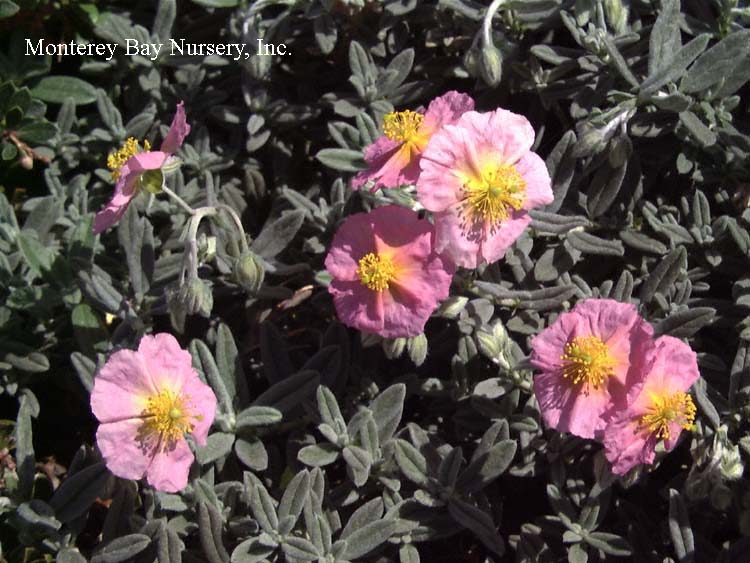
Helianthemum nummularium SUNROSE creeping woody perennials related to Cistus (Rockrose), usually growing to 6-8" tall by 2-4’ wide. Flowers range in color from dark red through pink, yellow, and white, all with small yellow stamens at the center. Need sun to part shade, average to occasional summer watering, average to good drainage. Frost hardy. Mediterranean. Cistaceae. rev 4/2008
‘Belgravia Rose’ closeup
habit
hot rose pink flowers against grey foliage. rev
5/2019
'Ben Nevis' (not currently in production) flowers
a rich orange, with red orange eye. Green leaves. rev
5/2019
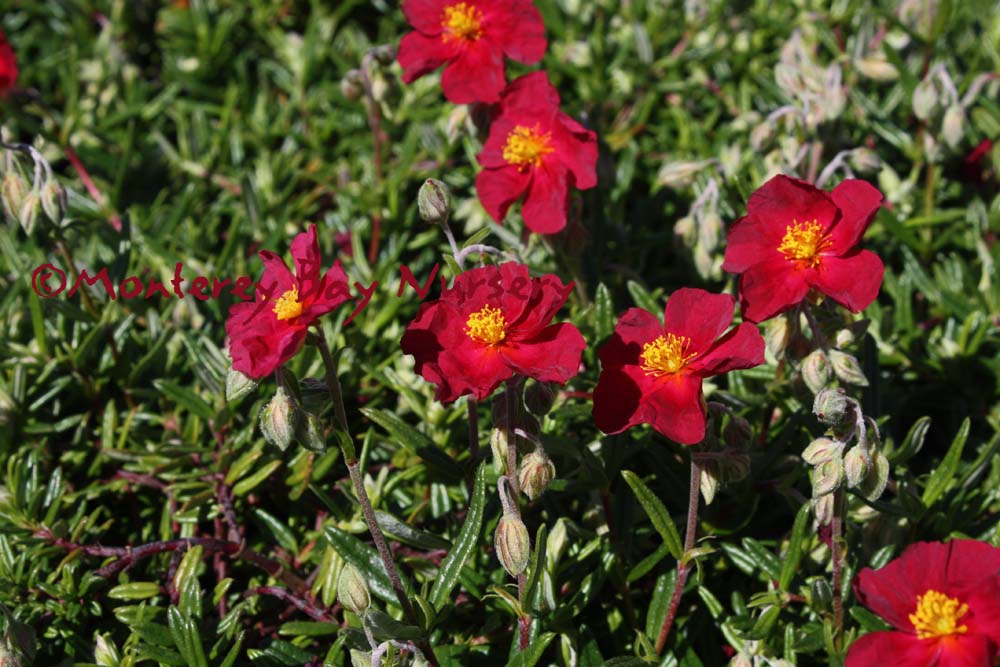
'Dazzler' (not currently in production) closeup
a "black" red, dark enough that older flowers can wither
under hot, sunny conditions. That intense red makes the bright
yellow stamens in the center a worthwhile feature. A great color,
fun to site in your garden. rev 5/2019
'Golden Nugget' perky
golden yellow flowers lots of golden yellow
flowers in spring, narrow dark green leaves look good all
year. About 12" tall and 18" wide. rev 5/2019
'Henfield
Brilliant' flowers
brilliant orange red against grey. rev 5/2019
‘Mesa Wine’ flowers
dark carmine-rose flowers, green leaves. rev 5/2019
'Wisley Pink' closeup
clear pink flowers against grey, tomentose foliage. rev
5/2019
'Wisley Primrose' closeup
more
flowers clear dark yellow flowers with grey
foliage as a background. rev 5/2019
Helichrysum splendidum (not currently in production) very close a silvery grey, woolly shrub for hot, dry places with clusters of small, yellow everlasting flowers. About 3' tall and wide, average to little watering. Looks good in masses, groups, or in containers. Nice contrast to the dark green of rosemary. USDA 9/Sunset zones 16-24. rev 5/2019
Heliconia
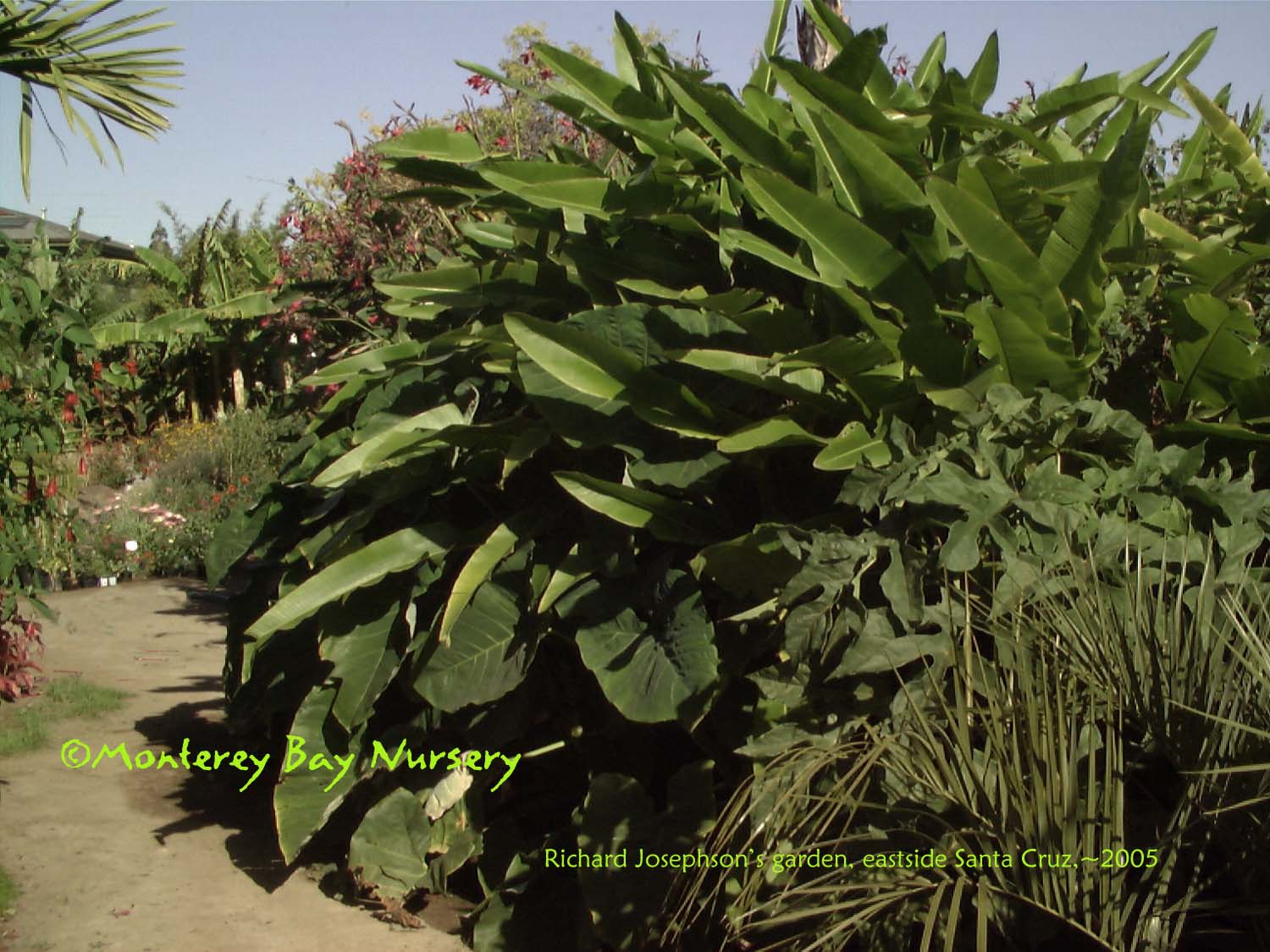
schiedeana ‘Fire and Ice’ young flower spike
Richard Josephson's yard
Bird of Paradise relatives, grown for their dramatic
foliage and "lobster claw" tropical flowers. The latter are held
on upright stems in this species, light yellow and emerging from
bright red stalks in an alternating zig zag pattern. All New World
Heliconias are pollinated by hummingbirds, if they work
your flowers they may set showy metallic blue berries. The
dramatic leaves can reach 6-8' in total length, with the narrow
petioles holding broad, smooth, 4-5' long blades vertically, then
eventually arching horizontally to downward. They will shred in
the face of strong winds and benefit from at least a partial
windbreak or siting away from the direction of storm winds. In
some shade and with good protection they become this plant's best
feature. This seems to be the only cool growing Heliconia
currently in the trade, and the most cold-hardy, and we've tried
about all of them. It survived the impressive 1998 freeze in Santa
Cruz (five consecutive nights to an honest 25°F), and foliage can
take about 28°F for short periods with damage to upward-facing
blades only. It soon spreads to form a large clump and can make an
impressive bank of neatly arranged, arching, pendant leaves, with
the somewhat inconspicuous flower stalks blooming underneath the
canopy. The flower stalks seem to initiate on mature (usually
second-year) culms which experience some degree of chill, as I
have images of plants in Santa Cruz starting to bloom in late May,
September and October. Use this plant as a bold focal point
subject, as a background “tropical jungle” filler, as a tall hedge
or as a large container item. It shines as an entryway or
porchside subject, also in commercial landscapes, indoors or out,
due to its extremely clean habit and lush appearance. Takes full
sun along the coast but does better everywhere with at least half
shade, and needs even more in scorching-hot inland areas. Roots on
established plants will to around 20°F. Likes rich soil and
regular watering to intermittent deep watering. Eastern Mexico.
USDA zone 9 (8b?). Central and southern Mexico. Heliconiaceae. rev
11/2018
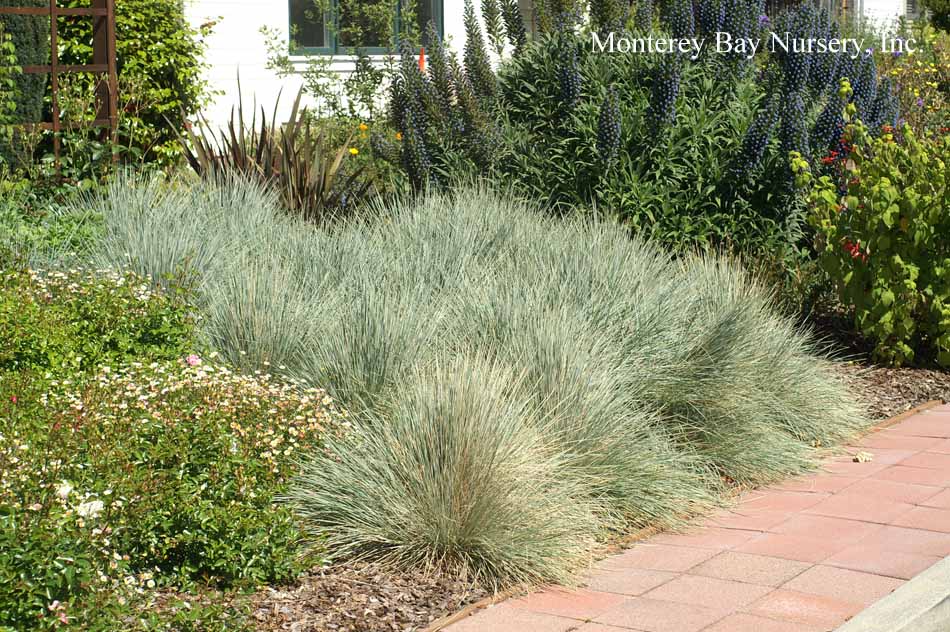
Helictotrichon sempervirens BLUE OAT GRASS habit groundcover
evergreen bunchgrass to 24-30" tall, 36" wide. Blades are narrow,
blue grey with powdery white bloom. Older leaves turn straw yellow
in winter. Bold, dependable, large scale ornamental grass, one of
the best and most popular varieties. As far as I can tell the
variety 'Sapphire' is identical in appearance and growth to the
unnamed trade "species" form, at least in California. In the
Northwest plant enthusiasts insist it is superior. Sun, little
summer watering, frost hardy. Europe. Graminae/Poaceae. rev 4/2005
Heliotropium arborescens ‘Fragrant Delight’ HELIOTROPE flowers closeup habit we are now growing this variety instead of our previous form, ‘Black Beauty,’ because it has the same fragrance but a much better growth habit. Its flowers are slightly lighter purple. It is an evergreen to deciduous perennial to 3’ tall grown for its pleasantly vanilla-like fragrant purple flowers, which are held in large, flat clusters for most of the year. Sun to part shade, average watering. Excellent in containers. Freezes to the ground at 25°F. Peru. Boraginaceae. rev 10/2003
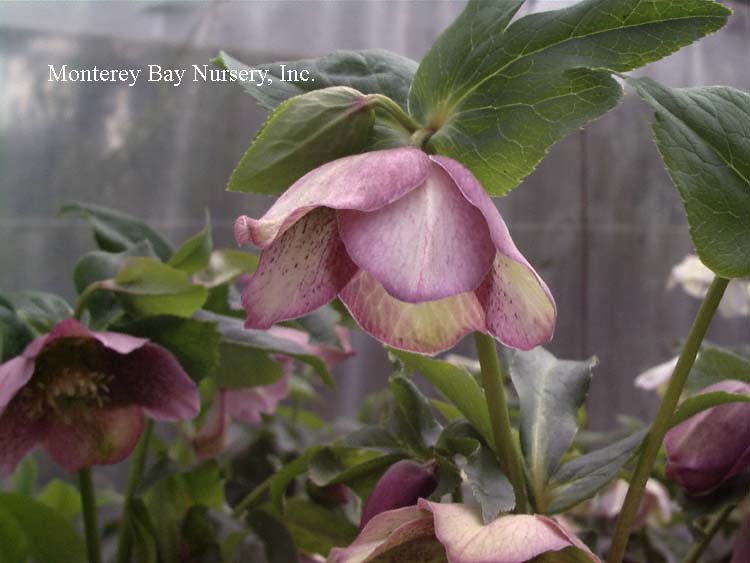
Helleborus CHRISTMAS ROSE, LENTEN ROSE evergreen to
deciduous perennials. Europe, Asia, Mediterranean.
Ranunculaceae. rev 9/2020
'Frost Kiss Molly's White' PP25,685 flowers rounded, cupped, dusky coral pink buds open to widely flared, outward-facing, very white flowers, with perky green shading on the petal faces. Very large, tough leaves are wonderfully marbled with gold, flower stems are deep burgundy. Lots going on, all of it very nice! To 12-24" tall, 24" wide. Late January to February bloom for us. This has repeated well for me in a very warm-summer, warm-winter Sunset zone 16 and I believe it should do well in most areas of Northern California and probably much of Southern California as well, especially if sited with protection from early morning sun to increase the chill-initiation of flowers. USDA zone 5. rev 2/2020
'Frost Kiss Dorothy's Dawn' PP28,010 large, striking leaves are marbled and veined with cream, tall branched spikes well above the leaves present flowers with emerge dusky coral pink and age to taupe and green on the face, deep burgundy maroon on the showier and more visible reverse. rev 2/2020
'Frost Kiss Penny's Pink' PP24,149 single flower, leaf whole bunch!a very promising, strong performer for us, also a favorite of the staff at Cabrillo College, after trialing many. This is a very good, vigorous, tall, deep rose red which has performed well for us the past three warm winters. As all hellebores seem to perform well here in our colder years, varieties like this one, which produce tall flower stalks every year, and don't slowly decline in vigor from our subtropical winter cycles, are by far the best choices for most California gardens. That color is of course the main feature, but the burgundy petioles and flower stems, and large, tough leaves marbled strikingly with broad gold veins make it valuable and eye-catching all year. Plant many! USDA zone 5. rev 2/2020
HGC Series ("Helleborus Gold Collection") CHRISTMAS ROSE HYBRIDS a series of hybrid selections, all of which seem to involve H. niger somehow. None are actually straight derivations of that species, besides what the company's patent labels may say. Perhaps in Europe, claiming your variety is H. niger may be a marketing feature? Besides its famous large, very heavy-textured flowers that species also has the cold hardiness needed for most countries that H. orientalis lacks. Here in California and Oregon claiming H. orientalis for heritage would be more beneficial, as those selections are usually better adapted to our drier, warmer Mediterranean climates and though variable, are generally much less chill-dependent. Also, unlike H. niger, which after going dormant its first winter never reappears, some of these new varieties come back more larger and more better in subsequent years. (If they don't, we drop them!!) Another very important feature is that their foliage is tough and almost uniformly dark green or blue green, often highly marked in an extremely attractive fashion, and their growht habits are always compact, whether low or midsized. You'll see some of these offered in full bloom as seasonal indoor gift/holiday items, similar to poinsettias or mums, as early as late November. They do well for that purpose in cool, bright indoor situations, and many can become excellent garden plants afterwards. Those thick, leathery leaves are also highly deer resistant, and now that I've lost a few H. orientalis seedlings to gophers I'll suggest you use a basket, especially considering their usually higher retail price point. Best in part or dappled sun, but can take full sun with regular irrigation. All need at least intermittent summer watering in my experience, even in our coolest-summer areas, for good growth/bloom at least and sometimes just to even survive. In full dense shade they often bloom poorly and slowly decline. In our California low-chill areas expect these HGC varieties to not flower at all, or flower on very short stalks, or flower on adequately tall stalks but naked, before any foliage emerges, in order of unhappiness. USDA 5-9/Sunset 1-7, 14-17. rev 1/2019
'Camelot' flowers deep, dusky rose buds open to creamy white, then age back to dark coral rose and hold on the stems for an extended season of color. Much like an improved 'Ivory Prince,' but much better warm-winter performance. Dark, tough, ornamental foliage, very compact group. rev 2/2017'Champion' Spring Trials 2011 flowers, closeup tough, durable, dark blue green foliage large sprays of big, open-faced, white to greenish white flowers, aging to blush pink, are displayed against wonderful light burgundy red stems and leaf petioles. This one looks like it has H. argutifolius, or perhaps even H. x. sternii (those red stems!) in its background, with its slightly greyish foliage and finely toothed leaf margins. To 15-18" tall, blooms late December through March for us. USDA zone 4/Sunset zones 1-8, 14-24. rev 2/2017'Ivory Prince' at Cistus Nursery, Portland flower closeup marbled, glaucous grey green leaves, dark wine red petioles and stems, compact habit, ruddy wine red buds opening to white then greenish white flowers. Plants are more robust in their second and subsequent years, and flower stalks will eventually reach to 12-18". This is a distinctive plant and worth having around for its foliage alone. This variety requires a strong, dependable chill! It is short rev 2/2017
Ice N' Roses® 'Red' enticing another dock order very deep, dark sultry red flowers on long stalks held above the robuts foliage, being large, boldly veined, dark, almost black-green leaves. Lots to hold your interest all year with this variety. rev 1/2019
'Ice N' Roses Pink' dock order closer even closer! rich, dusky pink flowers, petal margins nicely edged in deep burgundy-rose, on strong, robust stalks. Same outstanding, dark, leathery, durable, dramatic foliage. Good flower stalk extension and overall performance this past very warm winter. Looks like another goodie. rev 1/2019
'Ice N' Roses White' bees like it! another flower shot nearly identical to its "Ice" siblings as far as size, foliage and flowering performance as far as I can tell, but in a pearly white, the reverses of old, spent flowers shading a nice light pink. Another goodie, #2. rev 1/2019
'Love Bug' (not currently in production) just opening! rounded, very dark coral pink buds opened in February for us to display warm white to pale yellow flowers, heavily blushed with light coral pink and pastel green. Foliage is compact and hard, leaves are dark, rich, grey green against deep cranberry stems. A very compact grower, to just 12-15" tall and wide. USDA zone 5. rev 2/2017
orientalis LENTEN ROSE habit closeup another color another color another color Ernie and Marietta O'Byrne's garden this clumping almost evergreen perennial bears palmate, dark green leaves to 24" tall, with white to burgundy flowers, usually spotted, to 1 1/2" across in late winter or spring. Leaves slowly drop over winter, then flower stalks push through beginning in December and continuing through April depending on individual seedling variation, characteristics of the various strains, and the climate where they are growing. Part shade to shade, average to little summer watering. USDA zone 4-9. Asia Minor. rev 11/2018
we're growing new seed strains from the Netherlands, so far showing superior growth and flowering behavior in hot-dry summer/warm-wet winter areas, best of all we've tried. rev 3/2019
x sternii blooming, closeup habit leaf and stem detail a hybrid-species, the silvery grey H. argutifolius with the similarly-adapted reddish toned H. lividus. Both parents were separately honored with an RHS Award of Garden Merit. This is just like the familiar H. argutifolius but a little more interesting with its reddish petioles and stems for highlights and often reddish buds opening to pinkish flowers. Leaf color is usually the typical silvery grey but a few of the deepest red-colored seedlings have larger, greener leaves. Blooms same time, late winter/early spring. Use it just as you would H. argutifolius, part sun best, same coolish Mediterranean conditions, same drainage specs, same low water needs when established etc. USDA zone 6. rev 2/2020SINGLES
Red the acme! Deep, smoky, maroon red, single flowers. Good vigor and flower-stem extension. rev 2/2017
Pink the ultimate, light, medium and rose pink, some with bicolor effect, a few spots, semidoubles, etc. rev 2/2019
Purple the ne plus ultra! Sultry violet purple flowers, with a bluish cast on the reverse. rev 2/2017
White the pinnacle, purest white, sometimes highlighted with spots, some partially doubled. rev 2/2019
Spotted in a range of colors, stupendous. rev 2/2021
DOUBLES
Picotee flower 2 flower 3 stunning! a wide range of stunning colors, spots and shapes. rev 2/2017
Pink exquisite! rev 2/2017
Pink Spotted peerless! rev 2/2017
Purple sublime! Dark to light magenta flowers, doubled, with a center of ivory stamens. About 14" tall and clumping. Flowers can be floated in a bowl of water to enjoy. rev 2/2017
Red unparalleled! rev 2/2017
White
White Spotted
Yellow
Yellow Spotted
Winter Jewels (not currently in production) a full line of outstanding and always-improving varieties from Ernie and Marietta O'Byrne's famous Northwest Garden Nursery, located in the hills terminating the Williamette Valley's southwest corner, just west of Eugene, Oregon. Their hybrids come in an amazing range of flower colors from deep blue-black to dark burgundy red, apricot-orange, rust, green with black markings and white with dramatic maroon markings. Semidoubles and double are available in most shades as well. We are proud to be the first California nursery to offer these authentic, first generation seedlings. They continue to offer the hottest developments in Hellebore breeding. rev 10/2018
Amethyst Gem double light lavender pink. rev 6/2016
Amethyst Glow rich, purple coloring with a pink edge on these single flower. rev 4/2014-Suzy Brooks
Apricot Blush apricot yellow and pink, with light green to almost golden foliage when young, becoming darker with age. These are being slowly selected to retain their bright golden yellow foliage for more off season interest. rev 1/2013
Berry Swirl double violet reds. rev 10/2017
Black Diamond in Ernie and Marietta's garden maroon-black to smoky blue black, with a powdery white coating. Sublime. rev 1/2013
Blue Diamond single blue-blacks, with a powdery blue-white coating. rev 10/2017
Cherry Blossom semidoubles to full doubles, white heavily marked rose pink to rose red on the edges. Awesome. rev 1/2013
Cotton Candy in Chiqa's hands another individual softest salmon pink, double. rev 2/2015
Double Painted double light to medium pink with darker spots, quite variable as to doubling and size/density of spots. rev 10/2017
Golden Lotus double to semidouble pale apricot to soft yellows, often with reddish reverses or petal margins. rev 10/2017
Golden Sunrise clear light yellow, with light green to golden green foliage, especially when young. rev 1/2013
Jade Star single pale green petals, with a powdery white cast, are flushed and veined deep maroon violet towards the centers. rev 6/2016
Painted whites, petals broadly marked with deep maroon to red in the centers of the petals. rev 1/2013
Peppermint Ice double pink and white bicolored flowers. rev 10/2017
Ruby Wine single deep, intense violet reds. rev 10/2017
Sparkling Diamond a double white of the utmost clarity and perfection, petals often ruffled and fluted. Flowers are rarely flushed pink towards the center. rev 6/2016
White Lady Spotted large single white flowers, with maroon lightly spotted to forming a single large central blotch. rev 10/2017
White Pearl single pure white flowers, and some may have a frilly center too. rev 4/2014-Suzy Brooks
variegated seedling 1 seedling 2 seedling 3 seedling 4 seedling 5 seedling 6 highly variable seedlings, differing in pattern, leaf color (deep green through silvery), teeth along the leaf margin, overall size and amount of red on the stems, petioles and leaf reverses. Most are more variegated when in either juvenile-phase growth or pushing young mature-phase leaves. Almost all will be mostly green by mid-season. Pictured are a typical range of varied plants. rev 9/2018
'Winterbells' heavy January bloom, our first plugs a look inside those flowers new plus old a good performer here, would not stop blooming the first year we grew them, from summer until the following spring. That's a good indication it needs very little chill to initiate new, mature eyes. Plants held over winter always break dormancy well, first with a reliably heavy show of small greenish-white flowers with rosy pink sepals, then a dense cover of dark blue green leaves, tough, leathery and snail/slug resistant. Nice reddish petioles and flower stems provide a little more visual interest as well. To about 12-16" tall by a little wider. This is a very wide H. niger x foetidus cross, sometimes referred to as a hybrid-species x sahinii. Seems better adapted to our drier Mediterranean conditions than most other species and hybrids we've grown, especially anything else with H. foetidus parentage. USDA 5-9. rev 3/2019
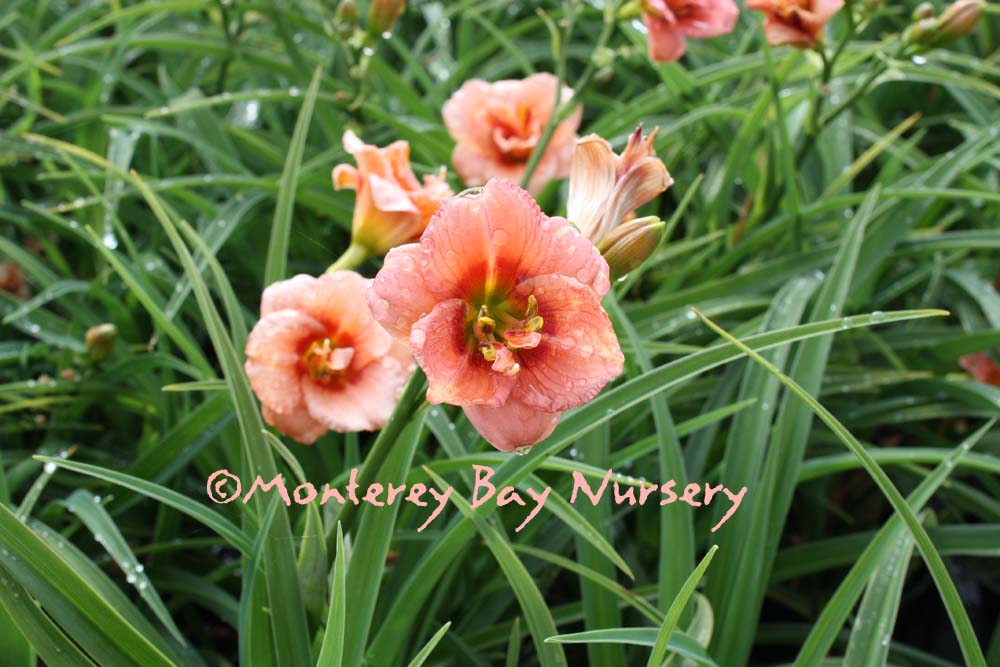
Hemerocallis hybrids DAYLILY tough deciduous or evergreen rhizomatous plants for sun or mostly shade, often needing little summer watering. They often form large clumps, and can be used as a large scale groundcover. Colors range from yellow and orange through chartreuse, white, pink, lavender, burgundy maroon, purple, and red. While they are raised from Maine (some varieties) to Florida, and Seattle to San Diego, in the end daylilies like warm days. They also like warm nights, or at least evenings. Performance in cool coastal areas or other regions lacking summer heat will be poorer than in those areas with a more continental climate. Sunset zones 1-24. Mediterranean. Liliaceae. rev 3/2003
Daylily petal color is determined by several
factors present before the flower opens. The best daylily colors
come with cooler daytime temperatures, night temperatures above
60°F, and relatively high humidity. Soil temperature also seems to
be important. Plants in containers, especially in warmer areas,
can be expected to be more melon-toned than when in the ground.
Temperatures warmer or cooler than optimum will produce paler,
colors. Delicate "watermarkings" on the petals may be lost except
under ideal growing conditions. Just as importantly, high pH can
affect colors, so soil pH above 6-6.5 will also result in some
pinks and lavenders washing out to melon or orange. We have
noticed that plants in the ground can have flowers twice the size
of what is seen in containers, so expect flower size to increase
substantially after the plant is established. rev 9/2020
Daylily breeders have made great strides in
improving flower shape, color, substance, vigor and compactness.
Due to lowered demand we have reduced our formerly stupendous
selection to the following superior varieties we will have this
year:
CURRENTLY OFFERED VARIETIES:
‘Coming Up Roses’ evergreen. Ruffled rose pink flowers to 3 1/2", up to 25 buds, strong summer rebloomer. To 30". Strong summer rebloomer. rev 9/2020
‘Cranberry Baby’ semievergreen. A charming and dependable mini to 12". Bears ruffled cranberry pink flowers with a darker eye, to 3". Extended bloom. rev 9/2020
‘Magic Masquerade’ deciduous. The best dark eyed ‘Stella d'Oro’ type available, but a larger and more vigorous grower, to 2’ tall. Often semievergreen, usually very heavy blooming. Excellent overall garden, landscape and commercial installation variety. rev 9/2020
‘Purple Rain’ deciduous. Bright purple flowers to 3" with a darker central zone, to about 12" tall. Long season of color. rev 7/2007
‘Scarlet Orbit’ evergreen Brilliant red flowers to 6" wide, rebloomer. To 22". rev 9/2020
PREVIOUSLY OFFERED VARIETIES:
DECIDUOUS:
'Butterfly Charm' (not currently in production) cheery flowers stout stems hold multiple buds, opening to fragrant, deep yellow flowers on this dwarf deciduous (according to our rep Keith, who has grown it at his house north of Sacramento) reblooming variety. To about 18" tall, with arching foliage. Besides using it in garden beds and pots it is a nice addition to the veggie and herb garden if you want to use the thick petals in salads and as garnishes. These are nicely fragrant, mild, and of pleasant texture, much better than many I have tasted. rev 10/2011
‘Gentle Shepherd’ (not currently in production) closeup lots of flowers the best “white” daylily. To 30" tall. Great summer bloomer too. rev 7/2007
‘Outrageous’ (not currently in production) flower a large, striking, intense orange with a dark zone in the center. Good summer rebloom. rev 7/2007
‘Play Money’ (not currently in production) flower a small to miniature variety, somewhat like ‘Stella d'Oro’ but faster growing and more floriferous. Deep golden yellow flowers to 3" across are profusely produced through the growing season. rev 9/2020
‘Siloam Shocker’ v (not currently in production) closeup a deciduous variety with light buff flowers to 3 1/2" across, accented with a dark raspberry central zone and a green throat. Petals are nicely ruffled. A compact grower to no more than 2' tall and a heavy bloomer. rev 5/2005
EVERGREEN:
'Baby Darling' (not currently in production) closeup "purple" flowers (deep burgundy rose, darker in warm-summer climates) with a darker central zone. Small stature, evergreen, repeat bloom, to just 18" tall. Cute! rev 8/2010
'Big Gold' (not currently in production) flower an unnamed seedling, bears golden orange flowers to 6" wide with thick, durable petals. Reblooms. rev 7/2007
‘Crystal Cupid’ (not currently in production) flowers mini, growing to 14" tall. Bears lemon yellow flowers to 2" across. rev 9/2020
'Irish Elf' (not currently in production) bloom small buds produce 2" lemon yellow flowers on grassy leaves. A rebloomer too! 12-14" tall. rev 10/2010
‘Loving Memory’ (not currently in production) flower a "white" variety, with large, pale yellow flowers. Everblooming. rev 9/2020
'Little Business (not currently in production) raspberry red flower this 'Business' doesn't need much taking care of! Raspberry red flowers on a dwarf selecion to just about 15" tall, nice and compact. Rebloomer too! A nice addition in groups or as a grassy clump accent plant. Semi-evergreen. rev 8/2011-Suzy Brooks
'Monterey Bay Monarch' (not currently in production) flower large, warm apricot flowers, with deeper orange red zoning at the center, deeply beaded rim. A good rebloomer, to 18" tall. rev 2/2016 MBN INTRODUCTION-2016
Monterey Harlequin' (not currently in production) gold and maroon blossom intermediate height, and intermediate-sized flowers to 3" across that are marked deep maroon in the center. Nice presentation and petal-edge ruffle, good vigor and flower production. rev 6/2016
'Mini Pearl' (not currently in production) closeup melon pink flowers with a yellow throat. Small stature, evergreen, repeat bloom, to just 16-18" tall. rev 8/2010
‘Selma Timmons’ (not currently in production) closeup full, broad, heavy textured, apricot orange petals, with a narrow pink central stripe on each, and a heavily beaded, frilled edge. About 18" tall, evergreen, early to midseason plus it reblooms, flowers to about 4 1/2" across. Excellent! rev 9/2020
'Small Gesture' (not currently in production) double flowers a real cutie with semi-double to double flowers of melon with a rose colored eye and a green throat. About 16" tall and a rebloomer. So easy to grow in the garden or in containers. rev 1/2011
'Stella Bella' (not currently in production) flower an evergreen version of 'Stella d'Oro,' itself a great variety that isn't quite as great in California. This one does better, has nice dark green foliage, is evergreen below freezing, and has deep yellow to gold flowers to about 2" across on a plant less than 12" tall. rev 9/2009
'Strawberry Pudding' (not currently in production) closeup compact, bright pink, with a yellow eye. rev 7/2006
'Sunkissed Pink Lemonade' (not currently in production) deep rose pink, darker zone surrounds yellow eye. Compact, repeat blooming. rev 7/2006
'Tiger Time' PP 12,445 (not currently in production) closeup 3" orange flowers with a distinctive reddish zoning in the center, up to 35 buds per scape and self cleaning. Foliage is very rust resistant. To 3'. rev 6/2005
Yellow with Eye (not currently in production) flower unnamed semievergreen seedling has large yellow flowers with a violet red eye. rev 9/2020
Hemionitis arifolia fronds a charming little subtropical evergreen fern that bears large, hear-shaped fronds to about 4" long on hard, black petioles. To just about 4-6" tall and wide, it prefers small containers and spaces and neutral to alkaline soils. It will form babies on the leaf veins with age. Fertile fronds are longer than sterile fronds and slightlydimporphic. Southeast Asia. Polypodiacea. Protect from frost until further notice. rev 10/2007
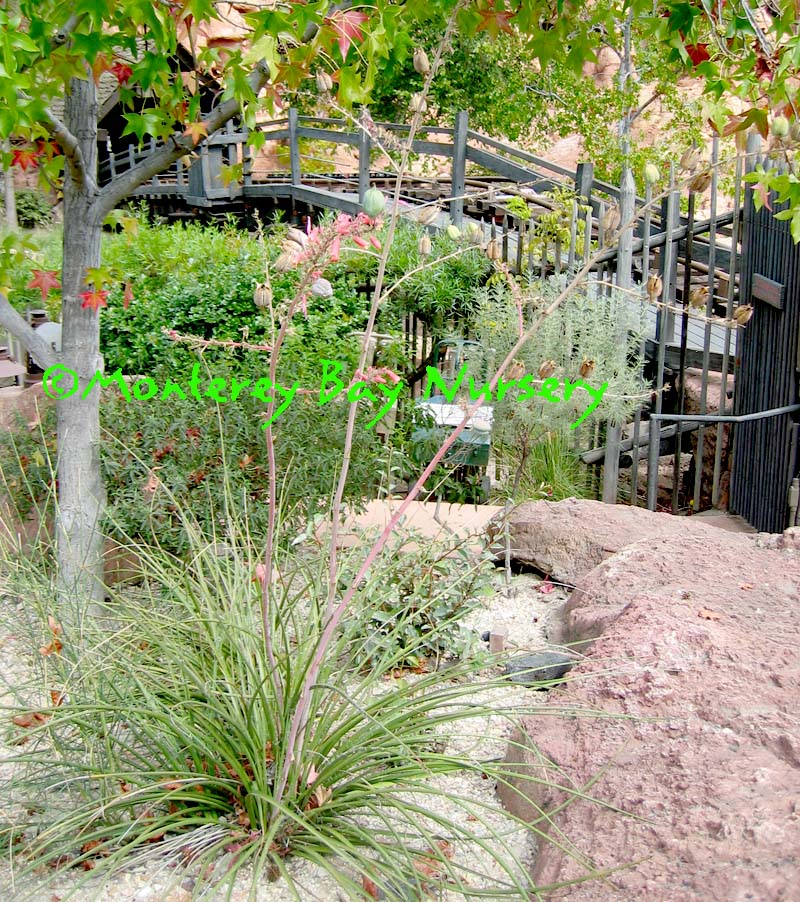
Hesperaloe yucca-like plants, also related to that group, lacking stems or trunks, growing as a clump of evergreen leaves with flower spikes produced at maturity. Asparagaceae. rev 5/2018
funifera GIANT FALSE YUCCA young botanic garden plant stiffly upright dark green leaves grow in a tight clump to about 4-6' tall, and produce conspicuous, gorgeous fibrils that spiral off the leaf edges, increasing in number with age. The tall (8-10'+) spike branches at the top into several very long, horizontal wands, bearing large creamy white to light green flowers. Rich in nectar and irresistible to hummingbirds. Flowering starts in very early spring and lasts for many months. Slow but very tough and persistent. Full, hot, dry sun, infrequent summer watering. USDA zone 7. Texas, Northern Mexico. rev 5/2018
parviflora RED YUCCA, HUMMINGBIRD YUCCA Thunder Mountain flowers not a yucca, but looks like one, and the narrow flower buds and spikes are indeed light red. The V-shaped, blue green leaves form a clump to about 3' tall, spreading at the top to 4' or more across with age. Leaf margins have attractive, curly white fibers which peel away from the edges but remain attached for a long time. The coral red central flower stalk reaches 4-5' tall, appears in summer after plants mature, flower petals themselves are yellow to light apricot in color. This plant is generally somewhat sparse and open, but that is part of the attraction, along with being spineless. Seems to grow well in cool climates but it is slower there than with summer heat, and it does very well in the hottest, desert-like conditions. Good drainage is all that's needed, along with infrequent irrigation where summers are long and severe. Great in containers for porches, patios. USDA zone 5. Texas, northeastern Mexico.U.S. Southwest. rev 5/2018
Heteromeles arbutifolia TOYON berries a tough native evergreen shrub, to 6-10’ tall and wide. Bears dark green, slightly toothed leaves and flat clusters of small white flowers. Showy clusters of berries turn deep red in late fall and usually last through late winter. Sun to part shade, good drainage, little or no summer watering, frost hardy. This is an extremely drought tolerant plant when established. California. Rosaceae. rev 2/2016
Heuchera CORAL BELLS, ALUMROOT about 37 species of compact clumping perennials distributed across North America, with more than a third native to California alone. As garden and landscape plants they are used singly, as edging, or massed for flower show, and more recently for increasingly interesting and colorful foliage. All are probably best in at least part shade with good drainage. Most need some summer watering but our native varieties can exhibit drought tolerance. All are good in containers, especially mixed planters. All are at least somewhat hardy, with the most tender being the Channel Islands native H. maxima (USDA zone 8) and the montane and Eastern species surviving to USDA zones 4-6. Most seem to need some kind of strong vernalization (chill accumulation) or they decline within a year or two but many recent hybrids show persistence in warm-winter climates. Saxifragaceae. rev 9/2020
'Amber Lady'
glowing
leaves just beautiful colors, peach, pink,
silver, and rose in these ruffled leaves! An easy, rewarding
perennial for part sun or shade. 12-14" tall and wide, blends
well with grasses or other Heucheras
in borders, beds, or containers. USDA zone 4. rev
3/2016-Suzy Brooks
'Amberous' (Baby Bells®) nice pink flowers warm foliage colors!
here's a nice, small-scale Baby Bells®
intro from Cultivaris, another in the immensely popular orange
range that people can't seem to get enough of. It's a compact
mound of glowing peach, tan, orange and gold, with small, hot rose
pink flowers held well above the foliage in spring on wiry, almost
invisible stalks. Celestial! Typical Coral
Bells growing conditions and requirements. rev 3/2019
'Amethyst Mist' foliage
dark burgundy heavily laced with silver. Tiny pink flowers
in late spring. Persistent. rev 4/2010
'Binoche' somber foliage very
dark reddish brown leaves with maroon undersides grow 12-15" tall
with white flowers in the summer. Easy to grow and maintain,
blends easily with other plants in containers, beds, sun, or
shade. Try it along a path or in front of roses. Average watering.
Sunset zones 1-9, 14-24/USDA 5. rev 3/2013-Suzy Brooks
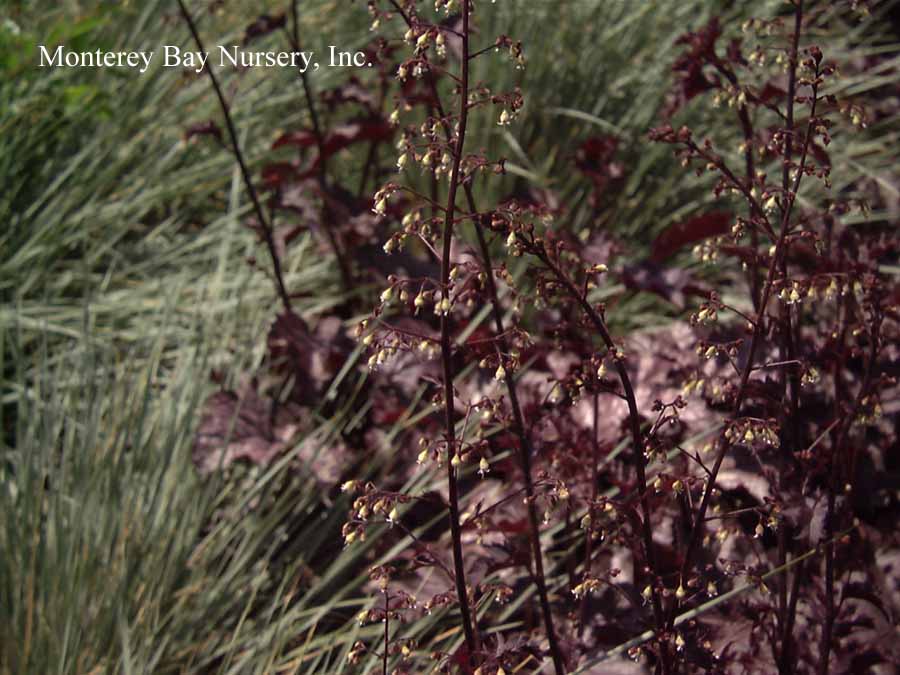
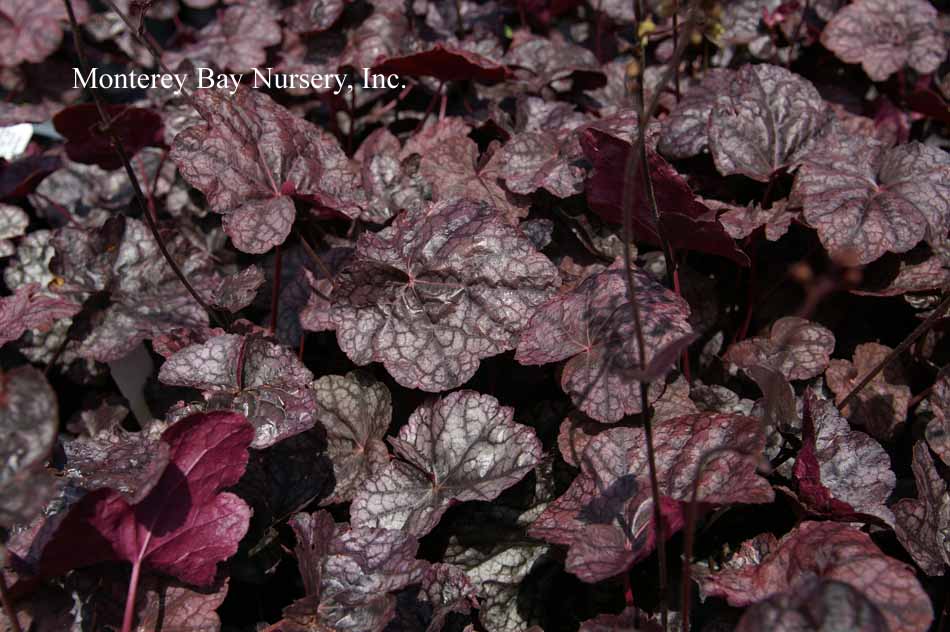
'Blackout' PP 20,613 CORAL BELLS tiny flowers nearly
black, shiny. silver veined leaves and rounded edges and a bright
maroon reverse add some wonderful contrast to the garden or
containers. Makes a tidy little mound 8-10" tall, 12-14" wide.
Will take mostly sun or mostly shade. Evergreen and easy to
maintain. Looks good with grasses, rocks, in groups, and as
an accent. Creamy flowers are produced in summer. rev
8/2011-Suzy Brooks
'Carnival Coffee Bean' warm leaves, pink
flowers not only beautifully colored leaves, all the
shades of coffee and cream, but the tall flowers are dark
pink and white. A mound of foliage 10-12" tall, 14" wide, perfect
for that transition zone between sun and shade. rev
4/2014-Suzy Brooks
'Carnival Fall Festival' autumn tones
beautiful colors of orange, pink, gold,
followed by green and silver. About 10-12" tall and 12-14"
wide, this charming perennial will take some sun or bright
shade with average watering. White flowers in summer for the
hummingbirds. USDA 5. rev 4/2015-Suzy Brooks
'Carnival
Limeade' foliage detail
pretties
colors, like a lime sherbet and vanilla popsicle, just
calling out to live near some dark, green grass for
contrast. Takes heat, being a H. villosa hybrid,
and likes morning sun or shade. About 12-14" tall and
wide, average watering. Good choice for the garden or in
containers. All Sunset zones/USDA 5. rev 1/2014-Suzy
Brooks
'Carnival Plum Crazy' silvery
purple jagged leaves in silver and
maroon with dark veins and burgundy undersides. An
easy-care perennial for morning sun or shade, growing
10-12" tall. Creamy white flowers in summer for the
hummingbirds. rev 2/2019
'Carnival Watermelon' peachy
keen another one of the Carnival series with very pretty
leaves, pink and peachy with darker veins aging to bronze
green. Easy to grow, low maintenance and with H. villosa as a
parent, it tolerates heat and humidity. About 10-12" tall,
12-14" wide. Flowers attract hummingbirds too. Morning sun
or bright shade, average watering. Sunset zones 1-24/USDA
4. rev 2/2014-Suzy Brooks
'Cinnamon Glaze' another Baby Bells®
Cultivaris introduction,
forms a dome of deep coral-burgundy leaves maturing to pale
orange-bronze and ultimately glowing, warm taupe. Small, narrow,
intense rose pink flowers are held on long, wiry stalks well above
the leaves. Transcendental! rev 3/2019
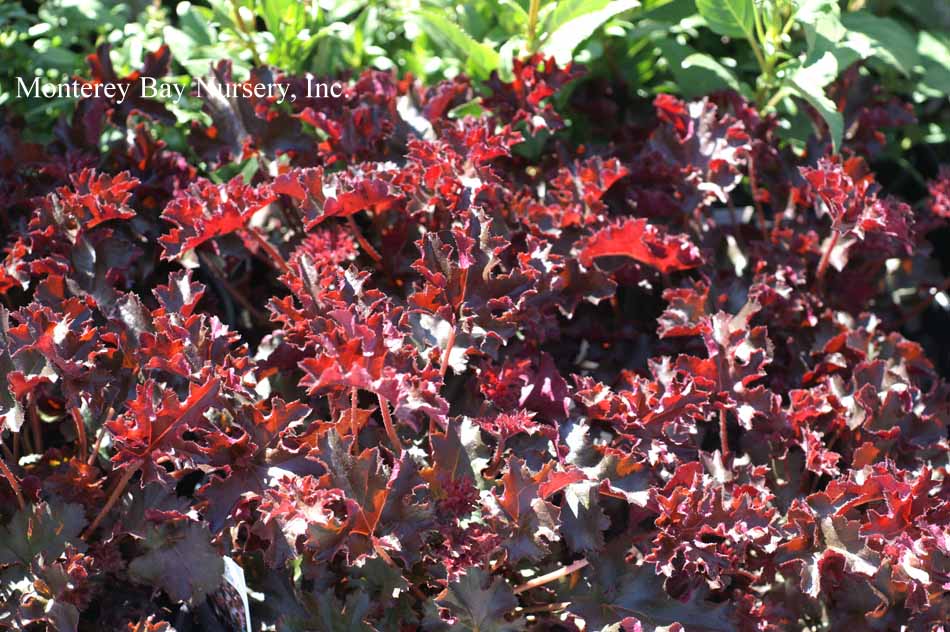
‘Crimson Curls’ PP 13,729 leaves a very
popular variety, with large, crinkly, maroon purple leaves with
finely curled edges. Flowers are white against stems the same
color as the leaves. Takes sun well. Can form dense clumps to over
2' across. This is probably the most persistent of all the foliage
type Coral Bells and is a reliable perennial even in mild winter
climates. rev 12/2004
'Frilly' PPAF
young rosette
mature leaf color a
honey-colored type, light coral peach when young, warm tan flushed
pale green at full maturity, reverses coral orange. Leaf edges are
nicely cut and wavy, especially noticeable when just pushing new
growth. Striking magenta leaf reverses. rev 2/2021
'Harvest Burgundy' CORAL BELLS leaves
really pretty leaf of silver, green, and maroon on
this easy to grow perennial. Sprays of white flowers
attract hummingbirds and are great cut flowers. About 14"
tall and 20" wide, it makes a lovely border plant in part
shade or full shade. Nice evergreen choice for containers
too. rev 1/2013-Suzy Brooks
'Harvest Lemon Chiffon' PP
19,033 new leaves
a new Heuchera
that begins with yellow foliage and turns chartreuse for
the season, sending up slender stalks of coral pink flowers
in summer. Blends well with other varieties and is very
attractive in a mixed group. About 12-16" tall, 24" wide. Softens
the edge of a walkway or takes that spot that gets morning sun and
afternoon shade. Average water. Sunset zones 1-9, 14-24/USDA
4. rev 1/2011
'Hercules' foliage this one is known for
its strength, stout and strong, with dark red flowers in summer.
Leaves are green, marbled with cream, grows in a clump about
12-14" tall and wide. Makes a fine border plant, especially in a
sun going into shade location, since it will take both. Easy to
grow and maintain. rev 7/2011-Suzy Brooks
'Mars'
wonderful foliage part of
the Planet Collection of Heucheras,
'Mars' has a pale lavender leaf with scalloped edges and dark
veins. A wonderful, evergreen foliage plant for part shade. Easy
to grow. Looks great in a mass, mixed with other
heucheras, and with grasses. In more sun, give it more water.
Bright shade is fine too. Hummingbirds like the little white
flowers on the slender stalks. Sunset zones 1-9, 12-24/USDA 4.
rev 2/2011
maxima
ISLAND CORALROOT nice
landscape, Branciforte Drive same landscape, different year
flowers one of
our California native species, endemic to the cliffs of three of
the northernmost Channel Islands (Santa Rosa, Santa Cruz and the
Santa Barbara/Anacapa group). Large, lobed or slightly cut bright
green leaves reach 4" across and become attractive burgundy-red
with age and cold weather. Tiny creamy white flowers are almost
globular and are held in tall, airy, open spikes in late spring.
Happy garden specimens can reach 3’ tall and 2' wide, and cluster
with age to form clumps. Full sun in cool coastal sites, part sun
to mostly shade elsewhere. Needs very little but occasional summer
watering. USDA zone 8. rev 10/2018
'Melting Fire' the fire the
'fire' is the bright red new growth and it 'melts' into the
older foliage that has turned maroon. Spikes of white flowers
in early summer delight the humminbirds and can be used in
bouquets. About 12-15" tall and wide. Dark red stems and
ruffled edges add to the complete package. Sun or bright
shade, average watering. Sunset zones 1-9, 14-24. rev 5/2012-Suzy Brooks
'Old La Rochette' why you grow it -
Filoli, Mother's Day 2011 flowers closeup
fancy
leaves an old, tough variety,
tolerating relatively dry shade but still with large,
pretty, lobed leaves of the newer and more delicate fancy
hybrids and a traffic-stopping flower display as well.
Grows about 2' tall and wide, displays a heavy show of
salmon pink flowers on tall stalks in spring. They attract
hummingbirds and make nice cut flowers. Reportedly a
hybrid involving our own Channel Islands Bloodroot, H.
maxima, this is a good choice for growing under
trees, especially natives, needing modest to little
watering once established. It is big, bold, stands above
competing weeds in a landscape and is reliably perennial
and just plain tough compared to most Eastern Coral Root
selections and hybrids. Part shade, at least average
drainage. USDA zone 8/Sunset zones 15-24. rev
9/2020
'Peppermint Spice' PP18009 great green silvery green leaves with maroon veining and rose pink
flowers for part or full shade. Leaves turn reddish orange in
fall. About 8" tall, 12" wide, flowers to 18" tall, for
hummingbirds or to add to bouquets. Average watering. Sunset
zones 1-9, 14-24/USDA 4. rev 4/2014-Suzy
Brooks
'Pinot Gris' PP19592 salmon, silver
and chartreuse a wonderful foliage plant
with rounded leaves of orange and silver aging to a rosy
salmon. Creamy flowers in summer. Grows about 10-12"
tall, twice as wide. rev 8/2014-Suzy Brooks
'Pistache' PP 19,585
foliage light
green leaves age to light yellow then tawny pink with cool
weather. Tiny flowers are white. rev 4/2010
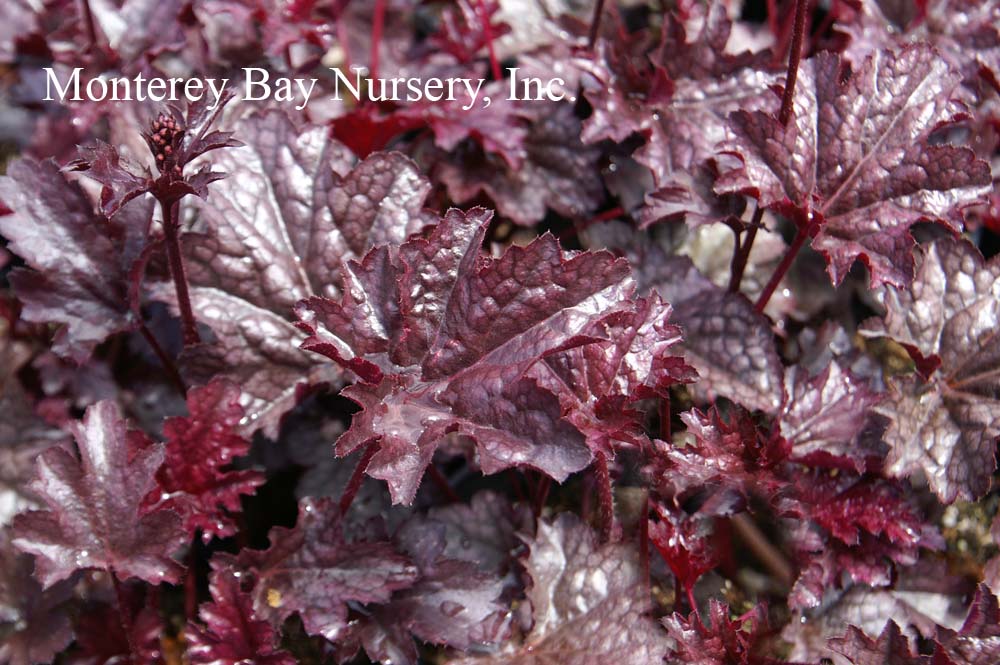
‘Plum
Pudding’ foliage
detail plum purple leaves the color of pudding, with a
violet overlay. Overall, this one has a dark maroon or burgundy
color, especially in the sun. Good vigor. Moderately cut and
frilled leaf margin. rev 5/2007
'Redstone Falls'
PP22394 warm,
warm colors this cross between Heuchera and Tiarella is a great one
for spilling over hanging baskets, walls, containers, or
as groundcover. Warm autumn colors show throughout the year -
not just in fall! Sun or shade, average watering. To about 10"
tall and 2-3' wide.Sunset zones 4-10,
12-24/USDA 7. rev 2/2014-Suzy Brooks
'Regina'
real rain
speckled foliage another great Heuchera to mix or mass
as groundcover or edging in sun or shade. Scalloped
burgundy and silver leaves make a colorful mound of
foliage and send up stalks to 3' with pink flowers,
just what the hummingbirds ordered! rev 3/2012-Suzy
Brooks
'Renoir' soft chartreuse
another of the 'Master Painters' series, this one with red veins
on yellow leaves turning to orange in the fall. Compact, 10-12"
tall with pink flowers in summer. Part shade, average watering.
All Sunset zones/USDA 5. rev 3/2014-Suzy
Brooks
sanguinea Ruby Bells
intense red
flowers instead of foliage, this variety is grown for
its fragrant, dark red flowers that appear in early summer.
(I know it is hard to believe, but once upon a time Heucheras were
primarily raised for their flowers.) They make a nice cut flower
and attract hummingbirds. The foliage is dark green and forms a
handsome clump 12" tall and wide. Part sun or shade, average
watering, Sunset zones 1-9, 14-24. rev 6/2011
'Snow Angel' at
Cistus Nursery leaves
winter leaves
flowers
leaves speckled to heavily marbled with ivory white. Bright red
flowers above. Smaller scale, less vigorous. But dependably
perennial especially with a nice, proper winter. rev 4/2010
‘Stormy Seas’ foliage
detail humble,
airy flowers another large, vigorous, dependable
grower, this variety has deep violet burgundy foliage, aging to
dark bronzy green with ashy grey and a rosy violet cast. The
undersides are bright burgundy violet. The leaves tend to angle
towards the sun, so in fall, winter and spring this variety
exhibits substantial color from light passing through the leaf and
illuminating the underside. Nicely cut foliage too! The flowers
are totally petalless, white and green, against dark maroon stalks
that are quite robust and can reach 3'. rev 8/2002
'Sunrise' red, red fronts and backs
deep claret red, with a slightly more violet reverse. This is an
interesting variety. Almost all Heuchera hold their leaves
horizontally though the best color is often on the reverse as the
upper sides almost always become more green or bronze with
maturity. This one holds its leaves more vertically and thus shows
off those wonderful undersides, most especially when backlit. rev
3/2021
'Swirling Fantasy' PP
14,542 new
leaves scalloped leaves of purple and
pewter are host to tall stems of red flowers on this
particular Coral Bell. Have you ever seen various kinds of
these together? They blend quite well, like colors on a tabby
cat. And one of the best things about these Heucheras is that you
can plant the same thing from sun to shade along a wall
or walkway, since they'll take both. About 12" tall and
15-20" wide. rev
3/2012-Suzy Brooks
‘Velvet Night’ foliage close up
border
deep, smoky, ash grey with rosy tones, deep violet purple
undersides, a flat finish to the upper leaf surface, and a low,
spreading, compact habit. The darkest of cultivars, or so they
say. Flowers are whitish and particularly inconspicuous. You just
want this one for its leaves. Vigorous, persistent, dependable.
rev 1/2003
'Venus' leaves a robust
landscape form with silvery green leaves marbled with taupe and
defined by maroon veins. White flowers can make a decent show in
late winter on established plants. Fast, vigorous, substantial, to
about 12" tall by 16" across. rev 4/2011
'Vulcano' warm, cozy color
they just keep getting prettier! This beauty is peachy orange with
silver on top, growing about 8-12" tall and up to 16" wide. Deep
pink flowers in summer. Give it shade or part shade with average
watering. All Sunset zones/USDA 4. rev 2/2014-Suzy Brooks
Heucherella a hybrid genus derived from Heuchera and Tiarella, with a little less in the way of flowers but lots in the way of foliage. Generally quite frost hardy, need rich, moist soil and average watering. rev 3/2014
'Kimono' PP12154 FOAMY
BELLS maple leaf shaped leaves are green
with dark veins, grow larger and rounder in summer and
offer some fall color. Light pink fls in summer. About
18" tall, it wants sun to part shade, avg to reg.
water. USDA zone 4/Sunset all zones. rev 5/2015-Suzy Brooks
'Sunspot' PP14825
leaves
coarsely lobed maple-like leaves, emerging chartreuse then aging
to golden yellow in strong light, with a maroon star at the
center of the leaf. Trim spikes to 16" tall bearing small, candy
pink flowers are produced in spring. Sunset zones 4-7, 14-17,
23-24/USDA zones 4-9. rev 3/2014
'Tapestry'
also green and
red, but different scalloped leaves are bluer in
spring, then green, with dark veins, then pink flowers
arise in early summer. A good choice for part or complete
shade in the garden or containers. To about 7" tall,
spreading to a foot or more across. Nice with an orange
variety of Heuchera. All
Sunset zones/USDA 5. rev 4/2014-Suzy Brooks
Hibanobambusa tranquillans 'Shiroshima' foliage detail Yacht Harbor containers the only species in the genus, it was found on Mt. Hibano and is supposed to be a hybrid of Phyllostachys nigra 'Henon' and Sasa veitchii tyugokensis. This named strain is the variegated form and grows as a moderately vigorous runner to about 16' tall, with stems to 1 1/4" thick, and large, 10" long dark green leaves strongly striped ivory white. It makes a great container plant and is especially striking against a dark wall or aged wood. Hardy to 0°F. rev 6/2004
Himalayacalamus a genus of cool growing, clumping bamboos native to Asia. Many are fine textured and offer wonderfully colored culms. Graminae/Poaceae. rev 12/2009
falconerii ‘Damarapa’ CANDY STRIPE BAMBOO striped stems at Strybing at Blue Bamboo Nursery, summer a wonderful, lush, fast growing clumping variety to 12-20' tall, with 1" culms. The new culms emerge deep coral pink and age to bright green with tawny yellow stripes. This variety is very similar in superficial appearance to Bambusa multiplex ‘Alphonse Karr,’ but that variety has conspicuously bluish leaf undersides, is not as rich a color when emerging, likes more sun, and has a darker green mature leaf color. In addition, the leaves often show a faint, broad silvery streak in the center of the upper surface as well as occasional fine white lines. This species is also even faster, and quickly fills in spaces and reaches to its mature height given enough light, water, and fertilizer. Its dense billows of soft foliage are particularly pleasing against its striped stems, and it makes a full container plant if you can give it enough water, better than most other bamboos. It likes at least part shade and does well in bright indirect light, but it will suffer in dark shade. It tends to bleach in full, hot sun or where it has reflected light. Give it average to rich soil, at least some summer watering, and high-nitrogen feeding if its leaf color or vigor are not to your liking. Remember, this is really just another giant grass so feed accordingly! This species was misidentified and formerly offered for sale in this country as Drepanostachyum hookerianum. Its young shoots are edible. Listed as frost hardy to 15°F, so it may be worth a try up to USDA zone 8/Sunset zone 5. Consider it reliable from Sunset zones 8-9, 14-24. Find more info on bamboo in general here. Himalayas. rev 12/2009
hookerianum ‘Teague's Blue’ BLUE BAMBOO most of why you grow it more stems winter stems young plant at Blue Bamboo Nursery lower Eastside real, true 'Teague's Blue,' the real deal, direct from Chris Stapleton. If it's good enough for Chris, it's good enough for us. However I still believe most of the color differences seen from plant to plant relate to climate and soil, with better color and foliage in richer, moister soils in cooler, more humid Northern California. This is a fast, stiffly upright, narrow grower to 15-30', with long graceful leaves, and dense stems to about 1" thick. With age it can form rather large, imposing clumps. Most mature plantings I know of have been hacked back at some point as they outgrow the usually too-small original planting space. The new culms emerge a wonderful powdery, almost turquoise blue color, with lavender tones thrown in. It is this unusually beautiful color that makes this bamboo so desirable and highly sought after. It prominently retains its culm sheathes until the joints produce a cluster of branchlets, when it is pushed off. With age the culms lighten to pale olive green to blonde, with red or maroon colors after they ahve been exposed to cold. Another nice feature is its foliage, which besides being naturally very dark blue green often has silvery markings on the upper leaf surfaces. The leaves are also quite willing to move with the direction of the prevailing breeze, and tend to hang loosely, parallel with the ground, as opposed to being held stiffly in species such as Phyllostachys aurea. They go with the flow. Full sun to part shade, average watering, at least average drainage, should take frost to a little below 20°F. It is markedly faster and larger in rich, moist, deep soils than in mineral, dry or nutrien-deficient soils. It certainly appreciates top mulch. In its native range the mature culms are used for production of woven or thatched products. Sunset zones 5-9, 14-24/USDA zone 8a. Native to high elevations in the Himalayas. rev 7/2009
porcatus NEPALESE BLUE BAMBOO, DWARF BLUE BAMBOO new stems more stems at the Huntington at Blue Bamboo raindrops foliage detail this is a dense, medium size, upright growing, clumping species that can be recognized by its powdery white coating on the new culms, aging light grey green to pale olive. Despite the common name don't think its culms are anywhere near as blue as H. hookerianus, Blue Bamboo, but is still a fine subject in its own right. It reaches only about 15-20' tall, with stems to 3/4", and it doesn't fall or arch over, making it great for narrow locations or use along walkways, driveways, tight areas, etc. Because of its limited but reliable height and predictable horizontal spread, it is one of the best screening choices, but with age most of its foliage will be above 5' and screening below is from the densely packed stems. Its foliage is typical of the genus, being lush, dark blue green in color, splayed artistically downward, and with a faint, silvery midrib highlight when viewed at an angle against the light. This species is from mid elevations in the Himalayas, and is barely hardy enough to be grown in parts of Oregon and Washington, but expect it to be cut to the ground or killed below 20F. Like most plants in this genus the farther north in California, the happier it is, but there is at least one very nice specimen at the Huntington Botanic Gardens (inland LA basin). Moist, partly shaded conditions in cool summer, warm winter climates yield the most bodacious examples, but adding shade, mulch and water in hot areas takes care of most negativity issues. Sunset zones 8-9, 14-24/USDA zone 9. Nepal. rev 2/2012
Hohenbergia about 60-65 species of quite
variable bromeliads native to Yucutan, the Caribbean, Colombia,
Venezuela and Brazil. Bromeliaceae. rev 10/2020
'Chocolate Tiger' nice 6" container plant orders being processed probably a straight selection of H. correia-arauji, this robust, easy grower has tall, narrow coppery maroon brown leaves splashed and zoned with broken horizontal white bands. We haven't seen them flower yet because you bought them all first. But the flowers themselves should be tubular, blue and emerging from very white buds held on a tall, bright coral red, branched flower spike. Leaves can reach 2-3' tall in a very narrow rosette, spikes can extend to 3-5', more if really happy. Mostly full to part sun for good leaf color and overall vigor but will tolerate considerable shade at the cost of turning green and shy blooming. USDA zone 9 with overhead protection. Brazil. rev 4/2021
Homalomena rubra 'Emerald Green' a houseplant or warm season porch/patio container plant whose dedicated mission in life is to be a lush, verdant fountain of shiny, deep green, heart-shaped leaves. It can get about 18" tall by up to 3' wide in the warmest, most humid conditions with age but is usually seen much smaller and it can be restrained simply be limting container size. Flowers are not showy, being very tiny and held on short spikes enclosed by a small green spathe, like a small, green Calla lily, but held on a spike much shorter than the leaves. Grow it in low or medium light, no direct sunlight, especially in bright/dry California, and water regularly but let it dry between waterings a little. It doesn't demand high humidity but looks better and puts on growth faster when present. This is strictly a houseplant, or indoor/outdoor porch and patio subject for WARM summer areas such as the Central Valley and Southern California. Like Caladiums, which are simply ungrowable here on the cool coast (they go dormant in mid-summer) it will decline quickly in continuously cold, wet soils and die by bacterial soft rot of the tuber. The only source for the botanical ID I used for this named variety was on the very interesting website I stumbled upon for a privately owned, non-commercial, tropical botanical garden in a medium-sized hobby greenhouse (by botanical garden standards) located in northwest Arkansas (!!). This amazing facility, The Exotic Rainforest, is the lifelong result of two tropical plant-crazed plant lovers, Steve and Janice Lucas, who have opened their collection to the public, free of charge (they do not sell plants!). I'll be stopping by sometime you can be sure. Araliaceae. Java. rev 9/2020
I can't remember if this is one of my houseplant varieties that lived fine underwater, but it might be. Back in the '80s I read somewhere that most houseplants are from the jungle floor, and that most commonly sold species are found naturally in the seasonally wet/dry areas of the Amazon basin and lowland SE Asia. Besides tolerating very low light levels many foliage layers existing beneath the highest tree canopies those native habitats can be inundated for several or even many months under seasonal floodwater, sometimes for most of the year. The rest of their year is almost always still relatively hot and can either be intermittently rainy or almost continuously dry, depending. Where it does rain in between it often does so in small amounts, barely wetting the ground. So these plants are preselected to be tough, used to abuse and well-adapted to extreme conditions. They do well with someone like me taking care of them.
Armed with this new knowledge and acting on sudden inspiration I impulsively bought about 20 or so random houseplant varieties, cheap, in 2" pots, Areca palms, pothos, syngoniums, scindapsis, aglaonemas, you name it. I washed the soil off and sank the roots into the coarse gravel of my 20 gallon aquarium. I tried both with and without an undergravel filter, it didn't seem to matter. Only one or two varieties died, and then slowly, over 4-6 months - pothos? scindapsus? aglaonema? The rest lived fine for those few years until I got rid of the tank. I would get tired of looking at the same ol' scene and move everything around, or replace some with new varieties, just to see what would tolerate growing in an aquarium. How far could I push this crazy concept> I learned that yes, most houseplants either tolerate or do great with neon tetras swimming through and around them. Some never changed in size - no growth, no leaf loss - but a couple actually grew well, probably from having the aquarium light. Almost none died. I do remember the Areca palm seedlings (Chrysalidocarpus) did make good growth, and really started movin' out once the leaves started to rise out of the water. I would just cut those back to under the water.
It was a lot cheaper than buying real aquatic plants and that tank looked very natural, very realistic, and quite dramatic. much better than some loose, anemic-looking pond plants randomly floating around. If you've seen video of tropical fish swimming around in the Amazon during the flood season, it looked exactly like that. Just don't blame me if you try this and your plant (or fish) dies. No sells these or represents them to be aquarium plants, but if you are willing to lose the plant you might be surprised at what it can do. rev 9/2020
Hops (Humulus lupulus)
Huntington Herb Garden
maturing flower clusters
you know why you need some in your yard. Fast, tough
deciduous vines that quickly climb to the top of available
support. Large, light green hop seed-heads form a the tops of the
stems in late summer - they have a bitter, soap flavor and a
perfumy to somewhat skunky aroma, depending on variety and to some
degree growing conditions. All our current varieties are
propagated by tissue culture from virus-indexed plants, viruses
being one of the most commonly encountered factors affecting vigor
and crop quality. They are quite commonly found among cutting or
root-cutting propagated plants, which should be avoided. Always
work your plants only with freshly cleaned (mostly bright steel!),
bleach-treated clippers, and if you can't treat then don't cut!
You will need regular, laundry-strength Clorox, or their
spray-bottle Clorox Cleanup formulation, both of which are near 2%
active ingredient, or any other bleach product which can be
verified as being as to concentration. Be careful, percent-content
is no longer required to be listed on the label. Some
commonly-seen formulations are as low as .75%.Grow in full to
mostly full sun in good-quality soil with good drainage, adequate
to lots of water and fertilizer. Remember when established they
can stretch to 25' long/tall in a single growing season. We'll
leave off for now the fine details of growing, harvesting and
curing. Hardy to USDA zone 4, chill requirements are not yet
well defined for most varieties. However I have seen successful
commercial operations doing quite well in San Diego, growing an
array of commonly-available varieties, including these. Also Santa
Cruz County was an important hop-producing area early in the last
century. Native to Europe, Western Asia, North America.
Cannabaceae. rev 11/2018
Hosta clumping, winter-deciduous perennials, usually featuring large, broad leaves. Hosta varieties are somewhat confused in the trade as far as actual species designation, and correct classification is still being worked out for many. They need part shade to shade under our very clear, bright skies, with good drainage, rich soil, and regular watering until established. They are considered durable, tough, drought tolerant plants back East when established, which for California means “reasonably drought tolerant.” They are all very frost hardy, and many perform best with a strong winter chill. Some varieties (none we grow, as far as we can tell) appear to even decline quickly in the absence of strong vernalization such as you would receive in northern states. Most don't need those huge amounts, however, and in most cases the only result of less than desired vernalization is smaller scale plants than you would see in colder areas such as Portland or back East. Usually you can provide quite a bit of necessary winter chill by simply siting where their planting site will be well shaded in winter and hence protected from ground-warming and chill-negating winter sun. USDA zone 2-9/Sunset zones 1-17, 18-21. China, Korea, Japan. Asparagaceae, formerly Liliaceae. rev 9/2020
Other varieties appear to be partially summer dormant, growing during spring and staying evergreen during the heat of summer but shutting down active growth. Recent research has also revealed that many other varieties are the opposite, that is they are obligate very long day plants - they will flower and partially leaf out once chill requirements have been met, but also will fail to put on real growth until days are longer than 14 hours, leaving them easy targets for the slimy hordes of grazing snails and slugs. Others are simple long day growers, meaning they go into active vigorous growth around March 7-15, when sensed daylength is longer than nights. Overall, you are just going to have to accept that in California, with our shorter daylength, and shorter number of very long days, and much lower relative humidity, and generally lower vernalization, that your Hostas are NOT going to look like they do in Ohio or Portland, where they grow huge leaves and get big enough that you could hide in them. They can still be very nice border perennials and striking container plants but they will do it at a smaller scale.
Failure to control snails seems be THE major reason for their failure to survive in gardens here. They need reliable snail and slug control, which can be as thorough and permanent as a copper barrier or as easy and intermittent as a ring of Deadline every month or so when they are in leaf. For good control try using iron phosphate baits combined with a tic-tac-toe pattern of Deadline striped throughout your garden, especially any areas that show baby snails in spring and fall (indicating egg-laying areas). If you are in cool, foggy areas follow up with stomping because under moist conditions snails and slugs will actually metabolize the poison and just crawl away to graze another day.
The general rule for how to site
the varieties is somewhat opposite of what you would expect:
Chartreuse, gold, and variegated forms will take more sun (some
full sun), the blues and dark greens generally burn and want the
most shade. rev 9/2020
Currently in production:
Not currently in production:
'Dream Queen' big, round blue green leaves with pale yellow down the center. To 2' tall, twice as wide as it clumps, white flowers in summer. A real attention-getter! rev 4/2020
'Earth Angel' young quart plant you tried sing it, didn't you? I know you did. But you couldn't, none of us can, anymore. Can't go that high. This is a creamy-edged sport of the awesome 'Blue Angel,' one of the very most reliable performers here in California. Early emergence (critical!), low chill, leaves are a little harder for snails to chew on. Same powdery, glaucous cast as the parent, same deep ribs, heavy substance and gigantic size. Part sun, moist soils, will tolerate much drier conditions when established (but will never be A-grade drought tolerant, sorry!). Very good in containers, especially with a band of copper tape around the rim. USDA zone 2-9/Sunset zones 1-17, 18-21. rev 4/2016
'First Frost' award winning leaf color nice look juvenile-phase quarts thick, blue grey leaves have a creamy yellow margin that fades to white, lavender flowers appear later in summer. Hosta of the Year in 2010! To about 16" tall, 3' wide. Plant in part sun to full shade with regular watering the first year, tougher and less water dependent when established. Holds it's leaves until first frost. USDA zone 3. rev 4/2020
'Fragrant Bouquet' big white, fragrant flowers large pale lilac flowers are noticeably fragrant, they display nicely against the large, bright green leaves edged in white. California specs roughly 12-18" tall by 18-24" across, a little larger in areas of the state with more chill. rev 1/2019
‘Francee’ leaves quart crop starting bloom a H. fortunei type with somewhat narrow medium green leaves margined with clean white. Occasional streaks splash across the centers of the leaves as well. Flowers are light lavender in summer. A medium size grower to 2-3' across by 12" tall. Striking and very popular. rev 4/2020
'June' mature color, outdoor 1g juvenile phase, greenhouse quarts deep blue with chartreuse leaf centers, in splashes and streaks. Needs part sun. rev 4/2019
‘Krossa Regal’ leaves large growing selection that forms an impressive dome of frosty blue heart shaped leaves. Flowers are lavender on stalks to 5’ tall. rev 2/2003
'Queen Josephine' new foliage glossy light green rounded leaves with light gold to creamy white, slightly undulate margins. Relatively thick, snail-resistant foliage, a huge plus for California gardens. Light purple flowers in summer. To about 12" tall by 24" across. rev 3/2019
'Stained Glass' (not currently in production) textured foliage really nice. Large, broadly heart shaped leaves are a wonderful soft yellow color, almost iridescent, each with a neat, defining green edge. A good bloomer too, with light lavender flowers, and they're fragrant! rev 8/2006
'Sun Power' glowing leaves bright golden yellow leaves are best in high light, high humidity conditions, more chartreuse where low humidity calls for more shade. Mature plants feature bright coral red petioles. Light lilac purple flowers in summer. To 12-16" tall by 18-24" across. rev 1/2019
‘Wide Brim’ flowers young plant nursery foliage wide luscious blue green leaves with a gold margin, heavily veined and textured. Pale lavender flowers, midsummer. To about 3' tall, 18" tall. rev 2/2003
‘August Moon’ (not currently in production) leaves veined, textured, heavy leaves are crinkly and puckered, emerge light blue green then age to gold (chartreuse in deep shade). To 2-3' across, a foot or so tall, and takes quite a bit of sun. Flower are white blushed lavender, late summer to early fall boom. Vigorous, easy. rev 2/2003
‘Blue Angel’ (not currently in production) leaves another that could be called “the very best blue,” with powder-coated foliage forming a very large mound or dome to 3-6' across by 1-2' tall. (Expect the lower range at best in most of California.) Very pale lavender flowers are held on 3' spikes in summer. This one wants shade. rev 2/2003
'Christmas Tree' (not currently in production) young leaf a nice, ripply, dark green, heart-shaped leaf with a whitish margin and lavender flowers. The origin of the varietal name is unclear. To about 3' wide (under perfect conditions!!) by about 20" tall, excluding flowers. rev 4/2010
‘Frances Williams’ (not currently in production) leaves habit very wide, heavily veined, quilted, corrugated and puckered blue green leaves with a pale gold to chartreuse margin. Can reach 3-5' across by 30" tall in favored climates and soils. White flowers blushed lavender, summer. Discovered as a seedling in the 1930's and still one of the finest grown. rev 2/2003
‘Gold Standard’ (not currently in production) foliage more foliage broad, golden chartreuse to pale blonde leaves are heavily veined and quilted and edged in dark green. Color varies by amount of light exposure. A reliable grower for us, it should reach 3-5' wide by 12-18" tall in gardens. Lavender flowers, late summer. rev 2/2003
'Guacamole'(not currently in production) juvenile foliage broad, rounded, nicely rugose, chartreuse green, edged irregularly with chartreuse. A sport of 'Fragrant Boquet,' with the same large, fragrant, soft lavender flowers. Host of the Year in 2002, to 18-22" tall and wide. Takse some sun. rev 4/2010
'Hush Puppy' (not currently in production) flower with variegated leaves a real mini, just 6" tall, with short leaves to match, green with a white edge. rev 1/2019
‘Patriot’ (not currently in production) lavender flowers leaves a larger grower, this recent selection of excellent vigor has dark glossy green leaves with bold white margins, to 3-4' wide. Flowers are medium lavender in late spring or early summer. Reportedly a tetraploid sport of ‘Francee.’ rev 2/2003
'Potomac Pride' (not currently in production) nursery plants a fast, very dark, almost black green variety with rounded leaves and a high gloss. Flowers are small, pale lavender. Shade. rev 8/2006
'Robert Frost' (not currently in production) broad heart shaped leaves are deep blue green tastefully brushed ivory in broad strokes along the leaf margins. Typical pale lavender flowers. rev 8/2006
'Royal Standard' (not currently in production) young leaf big, somewhat pointed, deeply ribbed leaves, to about 2' across here. Summer flowers are white and highly fragrant. Rather sun tolerant. rev 4/2010
'Sagae' at maturity, very broad, ruffly blue leaves show edges deeply splashed and margined with soft yellow. Acclaimed by some as the best variegated Hosta. This one can get big, to over 6' back East. Pale lavender flowers. rev 8/2006
'Shade Fanfare' (not currently in production) clean colors green, heart shaped, leaves with wide creamy margins provide color and texture to a partial shady spot. With moist, rich soil, and regular watering, expect a clump about 20" tall and wide. Grow along with heucheras, fuchsias, or tiarellas. All Sunset zones/USDA 5. rev 4/2013-Suzy Brooks
sieboldiana ‘Elegans’(not currently in production) leaves habit luxuriant, almost round blue green leaves, heavily veined and textured and with a powdery blue white bloom, form a clump to 3-5' wide by 1-2' tall. Flowers are lavender blush, on shortish spikes, in late summer. Somewhat more snail resistant. rev 2/2003
‘Sum and Substance’ (not currently in production) nice clump flowers H. seiboldiana type. Thick, large, waxy golden leaves are more snail resistant than many other varieties. Vigorous, quick grower, holds up well in summer heat and warmer winters. Lavender flowers. To 4' or more across, by 2' tall, with broad leaves. rev 2/2003
Houttuynia cordata ‘Variegata’ (not currently in
production) CHAMELEON PLANT closeup flower commercial planting
this deciduous perennial bears short stems of colorful heart
shaped leaves, dark green with light margins flushed rose red,
especially during cool weather in full sun. Pink color will fade
in deep shade, and variegation will turn greener, but plants will
grow well there. Fast, spreading by underground stolons, and
reaching 2-3’ tall with heat and watering. Be sure to trim out the
all-green stems. The flowers look somewhat like tiny white
coneflowers, the foliage smells like cilantro when crushed.
Accepts little summer watering when established, but plants will
be shorter. Can be grown as a pond plant, butin wet garden
situations it can be invasive. Not very frost hardy. Eastern Asia.
Saururaceae. rev 8/2010
Hoya WAX PLANT about 2-300 species
of tropical and subtropical vines (mostly) native to Southern and
Southeast Asia and Australia. Starry flowers are intricate in
their construction, many are fragrant, some quite strongly.
Apocynaceae. rev 4/2021
pubicalyx young 4" plant narrow, lance-shaped dark green leaves to about 1½" across by 4" long are randomly splashed with white flecks. New growth is deep coppery red. Pendant dome-shaped clusters of starry, dark wine red flowers, up to 40-50 per cluster, are produced in late spring and early summer, they are quite fragrant beginning in evening. Leave the small flowering branches (spurs) on the plant, it will continue to bloom from those. Bright light, average watering, plants can take very cold conditions but not freezing, and soil should be kept drier during that period. Australia, Southern Asia. rev 4/2021
Huernia zebrina ZEBRA FLOWER fly's eye view is there, in the entire world, a plant as cute as this that also has a flower that smells like a decomposing rodent? Well I think not!! An easy grower, small in scale, a reliable bloomer and it stinks. What's not to like? Grow it in average succulent soil mix, in part shade, with intermittent watering during the warm season and less during the depths of winter. South Africa. Apocynaceae/Asclepiadecae. rev 10/2016
Humata tyermanii WHITE HARE'S FOOT FERN, BEAR'S FOOT FERN young plant very compact, dark green foliages, large white furry stolons. The foliage is about the same as Davallia but the roots are larger. This is relatively hardy, and can be grown outside where temps don't usually go below 15F. Shade, regular fern watering, protection from hot, dry conditions. Good in containers where its pendant, searching roots can be appreciated. Sunset zones 7-9, 14-24/USDA 8. China. Polypodiaceae. rev 8/2010
Hydrangea macrophylla HYDRANGEA, HORTENSIA also known as mophead hydrangeas, these are by far the most commonly seen varieties in California though H. paniculata and H. quercifolia selections are quickly becoming more common. These like at least part shade in hot, dry areas, will usually tolerate full bright shade and will enjoy about as much water as you can throw at them. USDA zone 5/Sunset 3-9, 14-24. Japan. Hydrangeaceae or Saxifragaceae. rev 11/2017
'Akadama' PP28860 flower cluster color deepening large clusters of deep red flowers which darken and deepen in color with age, becoming black-red. A heavy bloomer, with nice contrast between the saturated flower color and the shiny green foliage. A compact grower to 4-5' tall and wide, it's a great one for containers because of its restrained habit. Fall color is dark burgundy red. Very different. rev 7/2021
'Pistachio' PP25577 wild color display named for the red and green colors of the pistchio nut (does anyone still eat the red ones?), this is a crazy colored, reblooming full-flowered type. And it's only 2-3' tall, spreading 4-5' wide. Part shade or full sun near the coast, it likes an acid soil and regular watering. Nice one for containers, interesting cut flowers too. rev 6/2013-Suzy Brooks
L.A. Dreamin'® ('Lindsey Ann') PP26249 big and pink! . . I mean, blue . . or ??? flowers all mixed up this interesting new variety throws flowers in both blue and pink (and "blurple," as semifailed, almost-blues used to be known in the floral/seasonal greenhouse trade) at the same time, regardless of soil pH. Wide-petaled, fully sterile "mophead" flower clusters bloom heavily in spring and then repeat until late fall. USDA zone 5/Sunset all zones. rev 12/2018
'Lime Lovebird' PP27134 (not currently in production)
strong color
a dense, rounded grower with medium-sized flower heads, big enough
to wow and numerous enough to cover the plant. The chartreuse
flowers turn sharp magenta red starting from the petal edges and
progressing inward as flowers mature. A strong rebloomer that will
stay in color from spring through late fall in many California
gardens. rev 11/2017
paniculata PLUME HYDRANGEA a deciduous shrub or small tree up to 15' tall and wide, known for its wonderful long, terminal, conical to pyramidal sprays of flowers that usually start off greenish white then age to creamy white or even pink. New varieties can open pink and fade to maroon. Flowering usually begins in early summer, but off-season bloom can occur on any mature wood which experiences a modest amount of chill under daylight conditions. Features respectable to very good pink to dark red fall color. All varieties like well-drained sites, average quality soil or better, moderate watering until established, then a little less and afternoon shade in hot areas to help prevent blossom scorch. This species and all its varieties do extremely well as container plants, being much more tolerant of wet/dry cycles than regular garden hydrangeas (H. macrophylla vars.). Easiest maintenance is to simply cut them back as they're just coming out of winter. Native to Eastern Asia, Japan. rev 8/2018
note: all above text and images ©Luen Miller and Monterey Bay Nursery, Inc. except as otherwise notedquercifolia OAKLEAF HYDRANGEA late fall color grown for its wonderfully long, conical clusters of sterile creamy white flowers mixed with tiny fertile flowers, with spikes initiating with chill on mature stems, usually early fall but sometimes winter and early spring in many parts of California. Another worthy feature is its dependable fall color, usually dark maroon but in some varieties hotter orange red and sometimes gold, almost always held until real cold sets in. Flowers emerge green and slowly turn to white before turning a very attractive ruddy bronze. This is a fast, dense, rounded deciduous shrub to 4-6’ tall by 5-8' across, sometimes more with age, really good soils and regular watering. Its broad, thin leaves are dark green, light underneath, and ornamentally cut to somewhat resemble the scalloped leaves with pointed tips seen in Northern Red Oak (Quercus rubra), California Black Oak (Q. kelloggii) etc. The species itself grows with a spreading to arching growth habit, dwarf, compact and more vertical forms have been introduced. Leaves turn brilliant red to dark bronzy purple in fall, depending on growing conditions. Likes sun to full, bright shade and it's very frost hardy (USDA zone 5). This species is considerably more drought tolerant than H. macrophylla and can get by in more sun with little summer watering when established. It tends to rot out under very wet conditions but will also grow in poorer soils. Southeastern U. S. rev 1/2019
'Ice Crystal' (not currently in production) conical lacecap clusters this is a spring-summer blooming selection, bearing long cones of white flowers in lacecap clusters. The oak-like leaves are sharply pointed along the edges, they turn bright red in fall and hold for an extended period. To about 3-5' tall and wide, give it average watering, grow it in part sun or shade. USDA 5/Sunset all zones. rev 1/2019
'Pee Wee' spike a dwarf Oakleaf Hydrangea with handsomely quilted leaves, white flowers in roundish clusters and lovely reddish bronze fall color. It also has attractive bark visible after leaves fall in winter. Only 3-4' tall and wide, it's a great, easy-care shrub with interest in all seasons. USDA 5/Sunset all zones. rev 1/2019
'Ruby Slippers' flowers changing color fall color - plus flowers!! wonderful foliage color delightfully luminous, almost fluorescent pink to deep burgundy fall color, which starts ahead of other varieties. Long spikes of ivory white summer flowers slowly age to deep ruby rose, often blooming spring and/or fall too, if they experience cool temperatures during their growing season. A compact grower to approximately 3-4' tall by 4- 5' wide. Good for about 10 months or more of flower and/or foliage color in most of California. USDA 5/Sunset all zones. rev 1/2019
‘Snow Queen’ typical flower cluster very long, luxuriant flower clusters are densely packed with creamy white flowers. Habit is somewhat more upright than 'Snowflake,' flower clusters are a little shorter and stand a little more vertically versus its counterpart's longer but mostly horizontal spikes. To about 4-6' tall by 5-8' wide when happy and mature. USDA 5/Sunset all zones. rev 1/2019